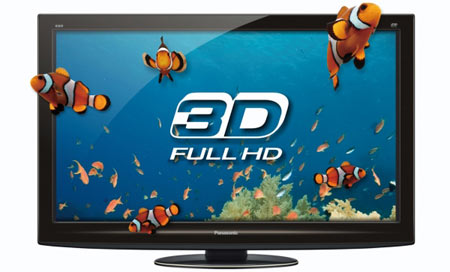
Panasonic GT25 / GT20
Panasonic GT25/GT20 review
Panasonic has released their new lower priced 3D plasma-TV called GT25 (in the US) / GT20 (in Europe). The GT series incorporates the Infinite Black panel as well as the new phosphor also used in the high-end VT25/VT20 series. This probably means very promising picture quality.
But how god is the Panasonic GT series? Is picture quality compromised compared to the popular and much acclaimed G20 range? And is 3D picture quality on par with the VT25/VT20 model? FlatpanelsHD will find out in this review.
Panasonic GT25 (US model) will be available in 42 and 50 inches called TC-P42GT25 and TC-P50GT25. Panasonic GT20 (EU model) will be available in 42 inches called TX-P42GT20E.
Subscribe to our Newsletter to receive e-mails when new reviews are online. We’ll soon publish our Panasonic D28, NEC PA271W Spectraview and Sharp LE925 reviews as well.
Panel size: 42" Resolution: 1920x1080 Response time: - Contrast ratio: 5.000.000:1 Brightness: - Colour support: 16,7 million colors Signal processing: 8 bit for each color Viewing angles (H/V): Angle Free Dot pitch: - Panel type: Plasma G13 (Panasonic) Wall mounting: Swivel stand: Dimensions (HxWxD): 65.4cm x 102,9cm x 8.2cm (without stand) Weight 20,5 kg Built-in speakers: Input formats: 480p/i, 576p/i, 720p, 1080i & 1080p (50, 60 & 24p) Inputs • VGA • DVI (can be converted through HDMI)
• Audio (type) (Audio in/out)
• SCART • S-video • Composite • Component • HDMI • Other Outputs • Audio (type) • SCART • S/PDIF Tuners • Analogue • DVB-T • DVB-T (MPEG4) • DVB-C • DVB-C (MPEG4) • DVB-S • DVB-S (MPEG4) Price and retailer:
| US retailer | UK retailer |
  |   |
Our first impressions
Panasonic’s new GT range basically has the same construction as the G20 model but the frame now has the same brown finish as the VT range.
Panasonic GT25/GT20 review
The stand allows users to swivel the TV.

Panasonic GT25/GT20 review
Inputs are connected on the back and some of the inputs are still pointing towards the back wall.

Panasonic GT25/GT20 review
The depth of the TV has been reduced compared to the 2009 Panasonic line-up but Panasonic is not competing with the very slim Samsung plasma-TVs such as the C8000/C7700.

Panasonic GT25/GT20 review
Test tools
Our TV signal is DVB-S (satellite) from Canal Digital and DVB-T (terrestrial). We also have an analogue TV connection. Testing is done with the DVE (digital video essentials) and Peter Finzel test DVD. Testing is also done with DVD, TV, Blu-Ray and Media center/PC.We use our own monitorTest. The software supports some of the traditional test patterns used to evaluate displays as well as some new and unique test patterns developed by the people here on FlatpanelsHD.
Sony PlayStation 3 is our Blu-Ray player.
All contrast measurements are based on the ANSI methodology.
Functionality
The GT series has the exact same functionality as the G20 model that we tested earlier this year. This means that you can expect Internet via Viera CAST, Wi-Fi, DLNA (on EU models), USB recording (on EU models) and ISFccc calibration options.Read all about this functionality in our G20 review here.
What’s new is an added DVB-S2 tuner (for the EU market) and a new 3D calibration menu.
Energy consumption
Below I have measured energy consumption on the 42-inch version.| Out-of-Box | After calibration | |
| Standby | 0,2 W | 0,2 W |
| SD+HD | 197 W | 174 W |
| 3D | 150 W | 190 W |
After calibration I measured energy consumption to 174 W. This is about the same as Panasonic G20 and typical for plasma-TVs.
I have also included a 3D energy consumption measurement. In the 3D mode the backlight is often maxed out to compensate for the reduction in light from the 3D glasses. Therefore the 3D mode also typically consumes more energy. I measured energy consumption in the 3D mode to 190 W which is actually low for a 3D picture on a plasma-TV.
Also, please note that the flat panel TVs uses less power after calibration. This is common on flat panel displays because many picture parameters are reduced during calibration.
Calibration on Panasonic GT25 / GT20
Below you can see an out-of-box measurement on Panasonic GT25 / GT20 in the Standard picture settings without the Eco mode enabled.
The graph says this:
The number on the left is the delta value. Delta is a difference between two factors; here it’s the difference between the measured color on the panel and the actual color that is our target.
The out-of-box result is not convincing and the color deviations are too significant. The gamma varies from 2.1 in the bright shades to 2.75 in the dark shades.
I now switched to the THX mode and took a new measurement.

The THX mode gave us a very good result with accurate colors and gamma very close to 2.2. The color temperature is a bit too low giving us a slightly too reddish picture but this is not uncommon with Panasonic’s plasma-TVs.
The color deviations are also low and notice that the brightness level is now also higher than on most plasma-TVs today. This is due to the new plasma-panel and the new phosphors that has been used in the GT20/GT25.
Even though the THX mode gave us a very good results we went on to tweak the TV with the ISFccc settings to see if we could improve the picture quality further.

What I wanted was to correct the color temperature and get slightly better color accuracy. I managed to this this with the RGB settings in the advanced menu. As you can see in the graph above I got very good results from GT25 after my calibration.
Gamma is almost spot-on at 2.2 and the color deviations are not perfect but very good. The Color temperature is now also very close to our 6500 Kelvin target.
Below are my calibrated settings.
| After calibration | |
| Profile: | Professional1 |
| Contrast | 36 |
| Brightness: | 0 |
| Colour: | 30 |
| Sharpness: | 0 |
| Vivid Color: | Off |
| Eco mode | On/Off |
| Intelligent Frame Creation | Off |
| P-NR | Off |
| Gamma | 2.2 |
| • R-Gain: | +1 |
| • G-Gain: | -3 |
| • B-Gain: | +5 |
| • R-Cutoff: | 0 |
| • G-Cutoff: | 0 |
| • B-Cutoff: | +2 |
I did not change much from the Professional1 mode but did change the RGB gain and cutoff settings.
Picture quality on Panasonic GT25 / GT20
In this section I go through picture quality with the calibrated settings.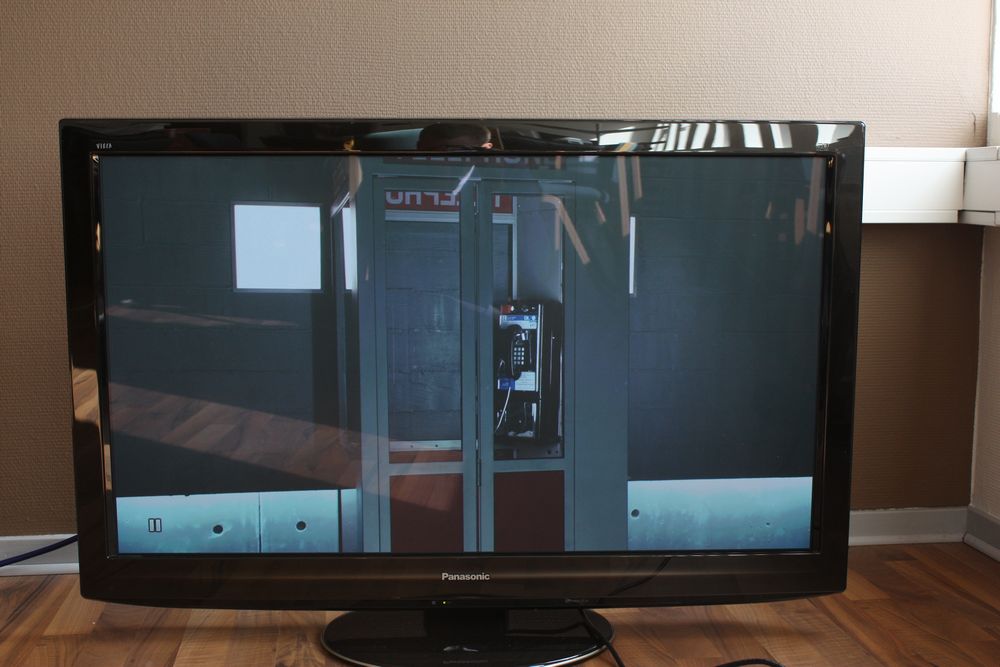
Panasonic GT25/GT20 review
I started by examining the reflection from the TV and it reacts very similar to the G20 model. Color intensity is maintained but the glossy panel reflects some light.
Reflections during daytime are reduced a lot compared to 2009 models and GT25/GT20 is quite good in this regard. The more expensive VT range still has better anti-reflective coating, however.

Panasonic GT25/GT20 review
We managed to get very good color accuracy from the TV but we’re also interested in examining color gradations. We do this with smooth gradients and on the GT range I saw some issues in the darker colors. Not all semi-dark colors were distinguished clearly by the panel and some bands and banding was visible, although subtle.
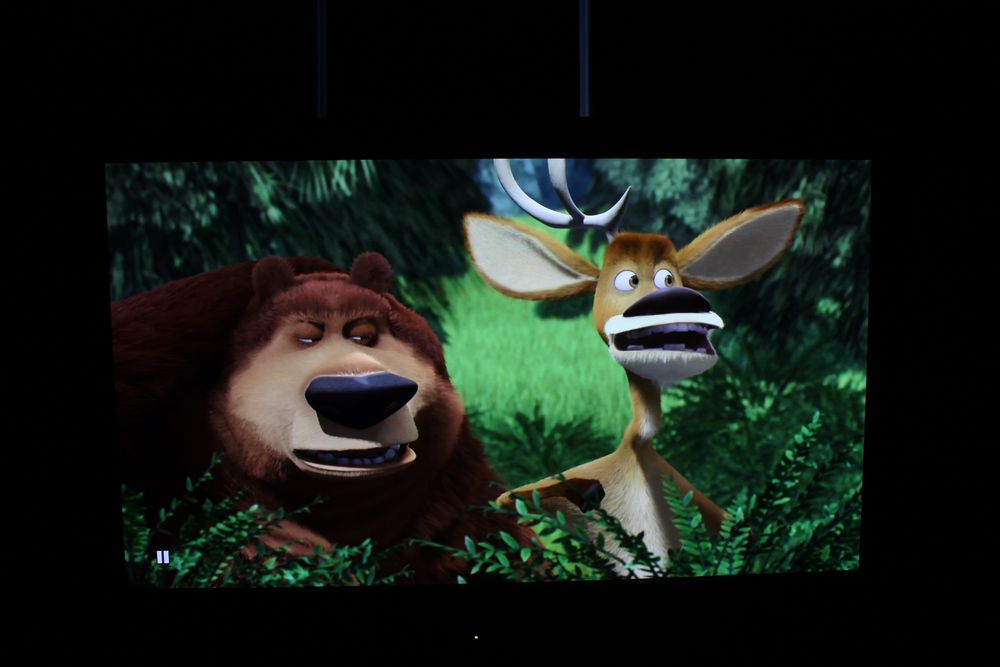
Panasonic GT25/GT20 review
This is the case because GT20 has slightly more PWM noise (plasma dithering) than the G20 model. The PWM noise is more visible than on Panasonic’s non-3D models such as the G20 and I think it’s fair to assume that the different phosphor and the 3D panel is the reason.

Panasonic GT25/GT20 review
Color gradation is by no means bad but GT had slightly worse color gradation than G20 and VT25/VT20.

Panasonic GT25/GT20 review
SD picture quality is good and similar to what we saw on the G20 model. This means detailed pictures because of above average picture processing. The detailing in dark scenes is also impressive and I saw no serious noise from the de-interlacing processes.
HD picture quality is very crisp and detailed and again the HD pictures are very close to that of the G20 that we tested earlier. GT20 has slightly more PWN noise but this is not visible from a distance. On the other hand motion reproduction has been reduced. Read on.

Panasonic GT25/GT20 review
I was eager to examine phosphor trailing on GT25/GT20 because Panasonic had proclaimed that it would use the same phosphor layers as the VT range. On VT25 we saw that the new phosphor greatly reduced phosphor trailing and therefore also exhibited less blurring and trailing in fast moving scenes.
And this GT range gave us the same impressive results. Phosphor trailing has been reduced to a minimum and I only saw very discreet green trailing in our stress tests. This is very positive and definitely one of the pros over the cheaper non-3D G20 model as well as the more expensive V20 model.

Panasonic GT25/GT20 review
I recommend that you turn of the IFC (intelligent frame creation) just like on other Panasonics TVs. This frame interpolation technology is fair but it also introduces some visible artefacts in the picture.

Panasonic GT25/GT20 review
The new phosphor gave us some minor image retention. We concluded, based on the VT25/VT20 review, that Panasonic’s new phosphor on the 3D models has more retention and this was supported by our recent Samsung C8000 review.
However, I rarely saw it in practice and Panasonic is still the plasma manufacturers with absolutely least retention issues.
Below I have measured black level and contrast.
| Out-of-Box | After calibration | |
| Black level | 0.06 cd/m2 | 0.06 cd/m2 |
| Brightness | 117 cd/m2 | 132 cd/m2 |
| Contrast ratio | 1950:1 | 2200:1 |
Contrast ratio +/- 50
After calibration I measured a black level of 0.06 cd/m2. This is not as low as on the G20 that gave us 0.04 cd/m2 black. We saw the same thing on Samsung’s 3D plasma and the 3D panels driving method and phosphor seem to give us slightly higher black levels compared to the non-3D variants. I guess this is the price to pay for 3D at the moment.

Panasonic GT25/GT20 review
The black depth is still good, however, and in practice the black level is pleasing. But I also have to say that the difference between 3D LCD-TVs and 3D plasma-TVs is not really significant anymore. As an example, Sony HX800 gave us 0.06 cd/m2 black

Panasonic GT25/GT20 review
Shadow detailing is good and similar to other Panasonic plasma-TVs. We experienced some plasma noise in some grey tones but could distinguish pretty much all of the darker grey tones, meaning that we get detailed pictures in dark movies and games.
Below I have examined the Panasonic GT25 / GT20 in a completely dark room to see if it has clouding, backlight bleeding or floating black issues.

Panasonic GT25/GT20 review
The GT series has no issues here and the black levels are stable. This is positive.
3D picture quality on Panasonic GT25 / GT20
We used the PlayStation 3 and a 3D Blu-ray player to test 3D movies and 3D games.Panasonic’s GT series is not bundled with 3D glasses so we had the same ones that come bundled with the VT25/VT20 model sent from Panasonic. Below you can see the 3D glasses.
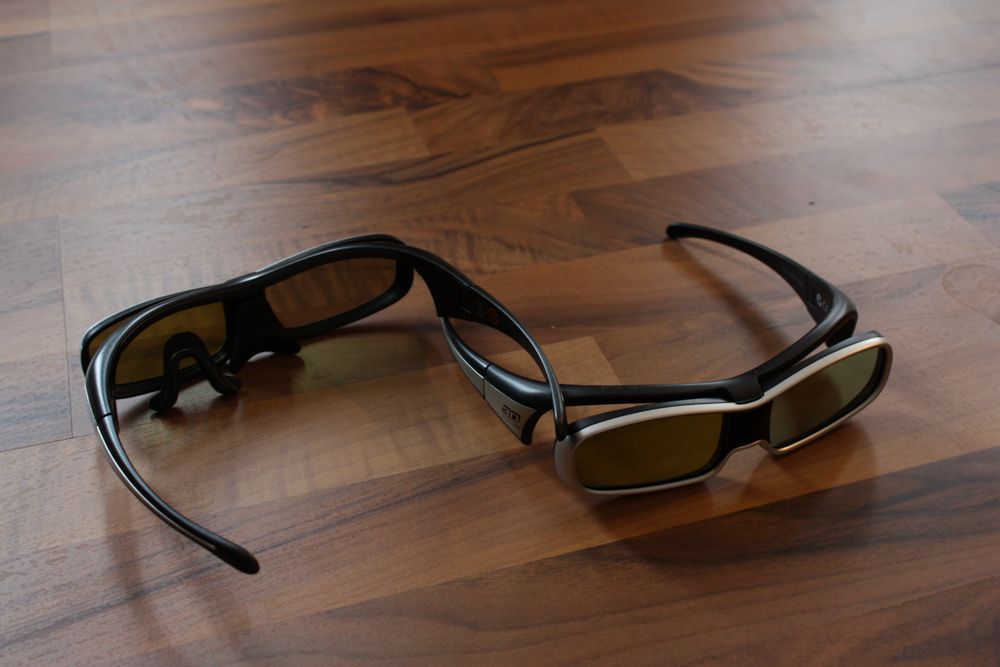
Panasonic 3DTV VT20 / VT25
I won’t say too much about 3D in general, and what you should expect, but instead refer to our Panasonic VT25 / VT20 review for a general 3D introduction.
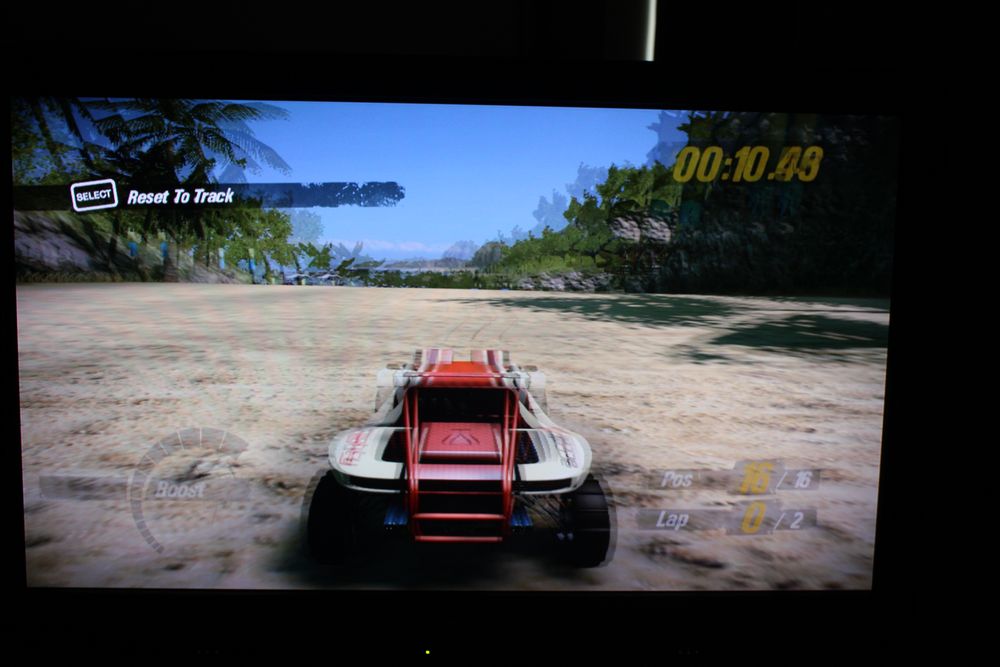
In this test I want to examine 3D depth, 3D picture quality, 3D crosstalk and finally include a small comparison to some of the other 3DTVs on the market.
Panasonic GT25/GT20 review
In order to output more light Panasonic has used the same construction that the VT range uses. This means new phosphors and a slightly different driving method. Even though thus gives us a higher light output from the panel Panasonic’s GT model is not able to output the same brightness value as 3D LCD-TVs such as Sony HX800 and Samsung C8000, meaning that 3D pictures in a bright living room are darker.
Panasonic GT25/GT20 also has some additional PWN (plasma noise) noise in the 3D-mode and the black level is not as deep as in the 2D mode. This is visible without glasses but when the glasses are on, both things are pretty much leveled out.

Panasonic GT25/GT20 review
Besides that the GT series is performing close to what we saw on the VT25/VT20. This means very, very low crosstalk and very impressive 3D-depth because of that.

Example: Crosstalk. This is not from Panasonic's TV, just an illustration
I only saw crosstalk very rarely (only if I really looked closely) and there’s a significant difference between this Panasonic 3D plasma-TV and the 3D LCD/LED models that suffers from much more significant crosstalk.
In fact GT25/GT20 is so close to VT25/VT20 in terms of 3D picture quality and crosstalk that I can’t really point out any relevant differences. And I have to say that GT25/GT20 - together with the VT range - provides us with the best 3D picture quality on the flat panel TV market today.

Panasonic GT25/GT20 review
So, what about the 2D->3D conversion that Panasonic has incorporated in the new GT range. Well, it’s there and it’s working but it’s not as aggressive as Samsung’s conversion. This means less perception of depth but a more natural look without huge gaps in the 3D levels.
But besides that I still think it’s worthless. Don’t use it. It’s so far from the good 3D discs out there that you’ll be disappointed.
Lastly, I should probably mention that all the picture setting options are also available in the 3D mode.
PC and Media Center
The TV supports 1:1 pixel mapping. In order to achieve 1:1 pixel mapping from a 1920x1080 signal you need to deactivate 16:9 Overscan in the setup menu.Viewing angles
Panasonic has improved the off-axis picture compared to previous year’s models, primarily because they have reduces the layers inside the plasma panel.This means that you see no reflections inside the panel and besides better off-axis viewing angles this also means better picture reproduction in very bright rooms or when sunlight is reflected in the panel.
The colors intensity is not reduced much from angles and contrast is maintained.

Panasonic GT25/GT20 review

Panasonic GT25/GT20 review
Sound quality
The speakers are fair but not great. The sound quality is more or less similar to the other Panasonic mid-range TVs and this means that voices are clear but the bass is weak. Also, if you turn up the volume the speakers/cabinet start to shrill.I recommend a separate sound solution for watching movies and playing games.
Conclusion
Panasonic’s new GT flat panel TV has much Panasonic’s functionality such as Internet, DLNA, USB and recording (on the EU models). The design is almost identical to the other mid-range 2010 models from Panasonic’s plasma range of TVs but the color of the frame has been changed to brown.Panasonic GT20 (in EU) / GT25 (in US) has convincing picture quality and it’s obvious that it builds on the foundation of the much acclaimed G20 series. The THX mode is very accurate and this creates a natural and detailed picture. The new phosphor reduces phosphor trailing even further and puts the GT model very close to the high-end VT range with the same phosphor. On the negative list, however, is the fact that the new phosphor makes black appear slightly greyer.
The 3D picture quality is beautiful and the GT range is a true value-for-money model in this regard. It’s more expensive than the G20 model so you’re basically paying for the added 3D option but it’s also a real alternative to the much higher priced VT20/VT25 model because of its very convincing 3D picture quality that has minimal crosstalk and impressive 3D depth.
All in all, Panasonic GT20/GT25 is a recommendable TV. If you don’t want 3D go for the G20 model but if you want a cheaper route into very good 3D picture quality, GT20/GT25 is the obvious choice for you.

Press the award logo to learn more.
Panasonic GT25 (US model) will be available in 42 and 50 inches called TC-P42GT25 and TC-P50GT25. Panasonic GT20 (EU model) will be available in 42 inches called TX-P42GT20E.
Price and retailer:
| US retailer | UK retailer |
| |
| Pros | Cons | Target group |
| THX picture quality | Black level slightly reduced | Home Cinema |
| Color accuracy | Inputs pointing towards the back wall | Living room |
| 3D picture quality | Minor retention | |
| Very low phosphor trailing and fast response time | Internet functionality limited |
Subscribe to our Newsletter to receive e-mails when new reviews are online. We’ll soon publish our Panasonic D28, NEC PA271W Spectraview and Sharp LE925 reviews as well.