Philips doubles down on OLED with tandem and OLED SE panels. The company is also launching its first LCD TV with RGB LED, while Google TV is out in favor of Titan OS. Here is Philips' 2026 TV lineup.
We have redesigned our TV line-up overview to include more data and technical information (under TV models click on to expand the view). We are also introducing an interactive TV compare tool (use to add TVs to compare tool). It's all powered by the TV Database.
The flagship OLED951 and OLED911 both feature the 2nd generation Tandem WOLED panel. This means significantly higher brightness and deeper colors than the more affordable OLED models. These will be available in sizes from 48 to 77 inches, competing directly with other flagship TVs using WOLED or QD-OLED panels.
The new panel also reduces reflections, which we have already seen firsthand. This is good news to buyers looking to place their TVs in modern, well-lit living rooms.
The flagship OLED951. Photo: Philips
A step down is OLED811, replacing last year's popular OLED810. It also features an improved, brighter panel with up to 2500 nits brightness, according to Philips. Finally, there is OLED761, which is Philips' first model with the new, more affordable OLED SE panel, aimed at capturing market share in the mid-range from miniLED LCD.
Also read: First impressions: Philips 2026 OLED and RGB miniLED
As for miniLED, Philips is not continuing its push in 2026. Instead, it is introducing RGB LED, where red, green and blue LEDs are placed behind an LCD panel to expand the color gamut – this requires HDR content mastered in the wider color space.
One of the two major changes in this year's 9- and 8-series is the addition of Dolby Vision 2, specifically Dolby Vision 2 Max, which brings additional features beyond the expanded range of brightness and color in HDR. This makes Philips the first TV maker to offer Dolby Vision 2 in OLED TVs – Samsung and LG are not offering it this year.
Also read: All our Dolby Vision 2 questions, answered
Dolby Vision (left) and Dolby Vision 2 Max (right). Photo: Eric Beeckmans / Flatpanels
The other major change is that Philips is dropping Google TV in favor of Titan OS. It is not Philips' own platform, but as the largest partner, the company says it has greater influence over the development of Titan OS. This relatively new TV platform includes most international streaming apps such as Disney+, HBO Max and Netflix, but lacks some regional and local apps.
Content from unsupported apps can be cast to the screen wirelessly via Apple AirPlay 2. Google Cast (Chromecast) is not built in, but a third-party app can function as Google Cast when open on the TV (though not in the background). Apps such as Apple TV and SkyShowtime are on the way, according to Philips and Titan OS.
Only OLED901 still runs Google TV, as it is based on last year's hardware platform.
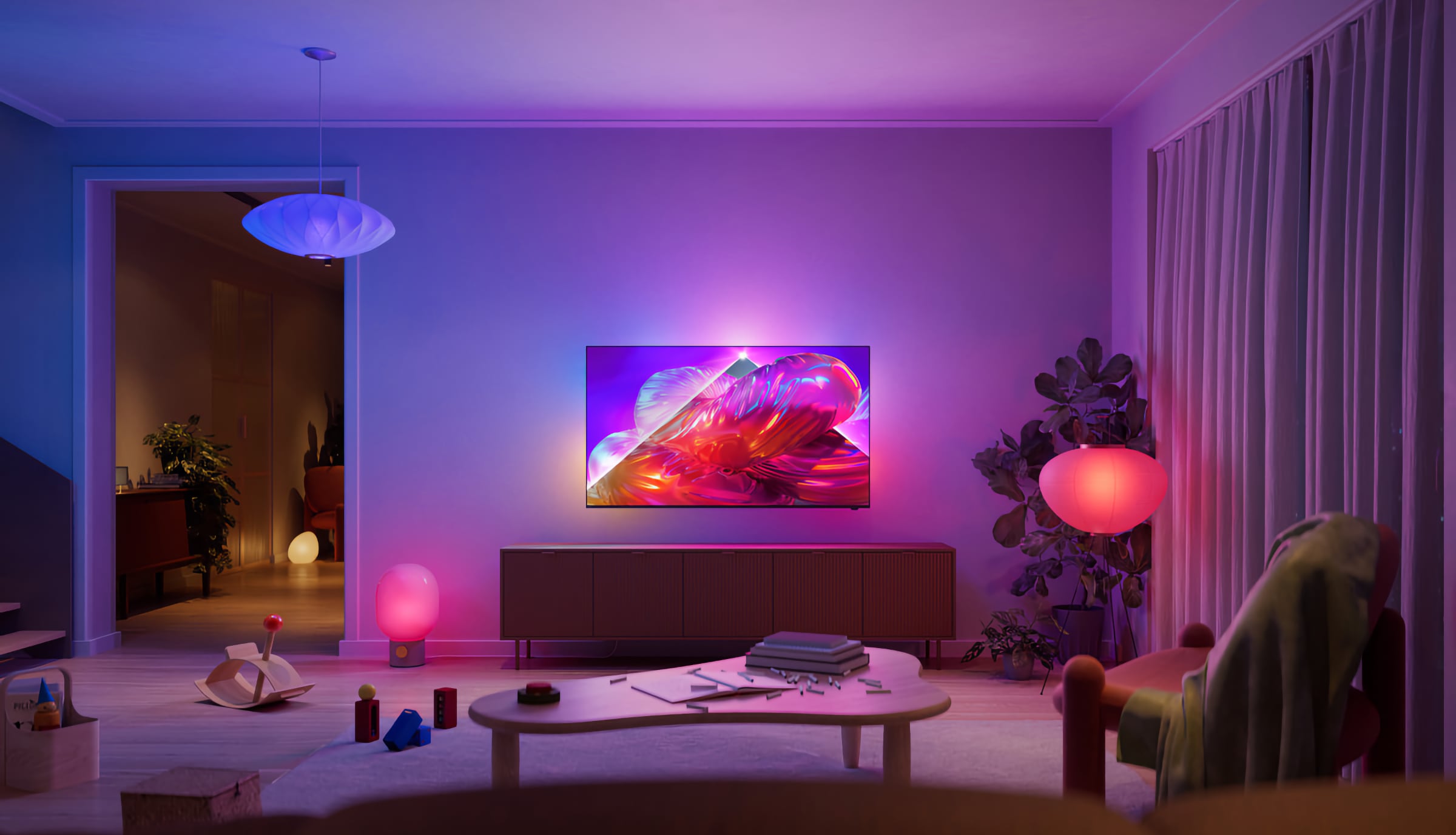
A new feature this year in most models is AmbiScape, an extension of Ambilight. It allows lights and bulbs in the living room to wirelessly sync with the TV's Ambilight colors. It now runs on the open Matter protocol, so support for lighting is expected to expand over time. At launch, Philips Hue, Wiz, NanoLeaf and IKEA are supported. You can read more about AmbiScape here.
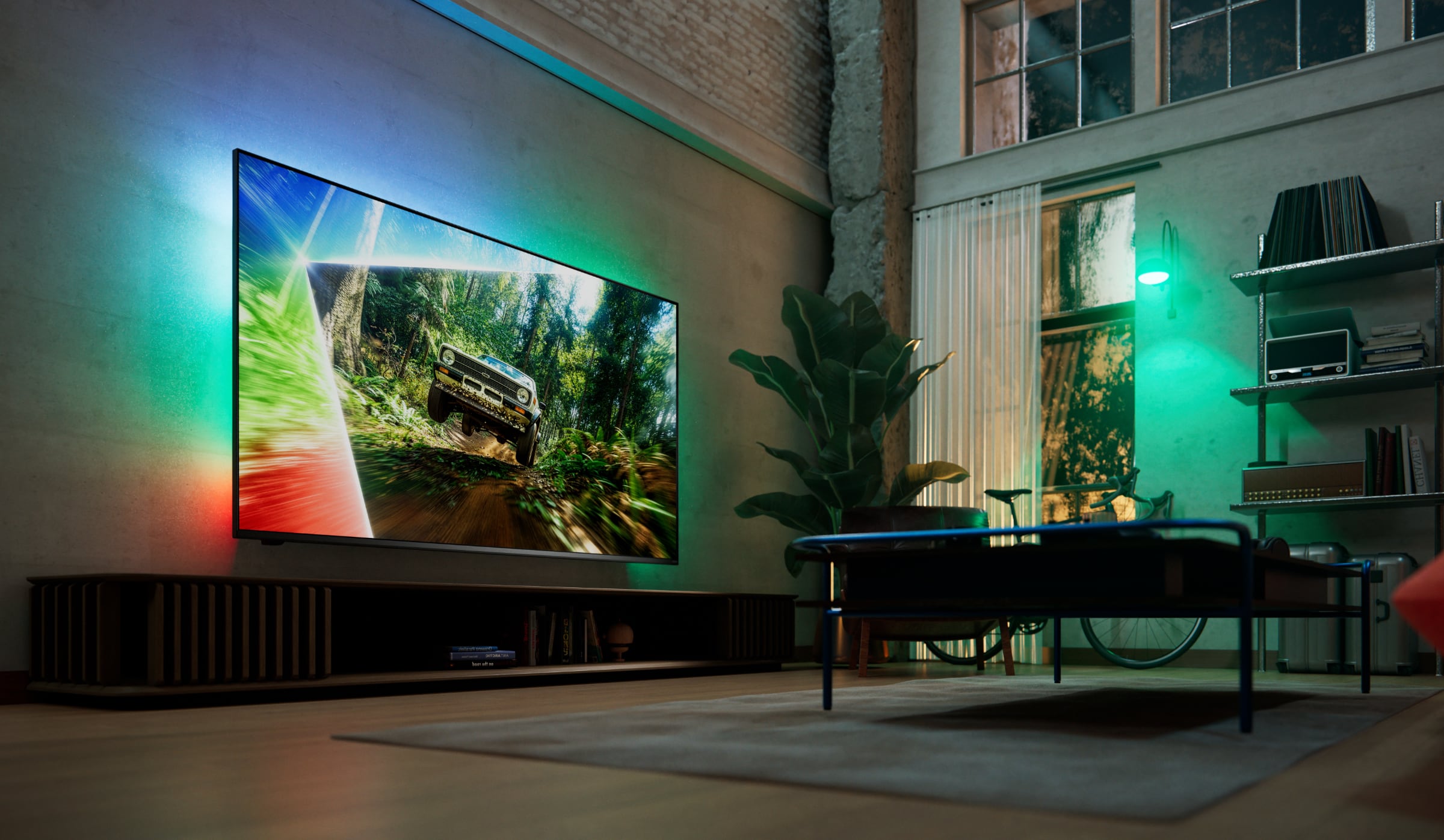
Most models feature 3-sided Ambilight, while the top models have 4-sided Ambilight, wrapping around the entire screen.
AmbiScape extends the Ambilight effect to other lights in the room – now via the Matter protocol. Photo: Philips
Another update is the move to the MediaTek Pentonic 800 chip, which finally enables four HDMI 2.1 ports in the OLED models and a couple of LCD models. See the overview below and use the orange icon to compare models. In the same models, WiFi has been upgraded to WiFi 6 (ax) and Bluetooth to version 5.4.
On the audio side, Philips continues its partnership with Bowers & Wilkins in OLED911. An external, traditional subwoofer can also be connected for deeper bass. Dolby Atmos is supported in many of the models. The wireless audio platform DTS Play-Fi did not gain traction and has now been dropped, but DTS audio is still supported.
Philips' P5 video processor has received a handful of new features, which we cover in this article.
Philips has no 8K models.
MLED981 is Philips' first LCD TV with RGB LED backlighting. Photo: Philips
Existing Philips features remain, including multi-HDR support (HDR10, HDR10+, Dolby Vision, HLG), FreeSync / G-Sync Compatible and more.
You can recognize a 2026 Philips TV by the model number ending on '1'. As a reminder: xxx1 = 2026, xxx0 = 2025, xxx9 = 2024, xxx9 = 2024, xxx8 = 2023, xxx7 = 2022, xxx6 = 2021, xxx5 = 2020, xxx4 = 2019, xxx3 = 2018, xxx2 = 2017, xxx1 = 2016.
The line-up overview will be updated continuously to reflect any changes or new models announced by Philips. Once the TVs become available, the model name and size will become an active and clickable link to price comparison or retailers.
Sign up for FlatpanelsHD's newsletter
The latest news, in-depth articles, reviews, and exclusives in your inbox.
TV models
Compare
Select up to 5 TVs from the list (vertical scroll on smartphone screens) with . Press 'Close' to return to the TV model line-up view. Remove TVs with 'x', or use 'Reset' to remove all TVs.
Sign up for FlatpanelsHD's newsletter
The latest news, in-depth articles, reviews, and exclusives in your inbox.