Sonos recently rolled out a batch of new features, including AI speech enhancement, TrueCinema, and Personal Home Theater for Two (with Ace). Here are FlatpanelsHD' first impressions.
The new features were added through two major software updates in May and June. At a launch event at its European headquarters in Hilversum, the Netherlands, Sonos formally introduced the new features.
Here, Sonos engineers and product specialists gave FlatpanelsHD and other media a behind-the-scenes look at the technology, answered questions, and let us try it all.

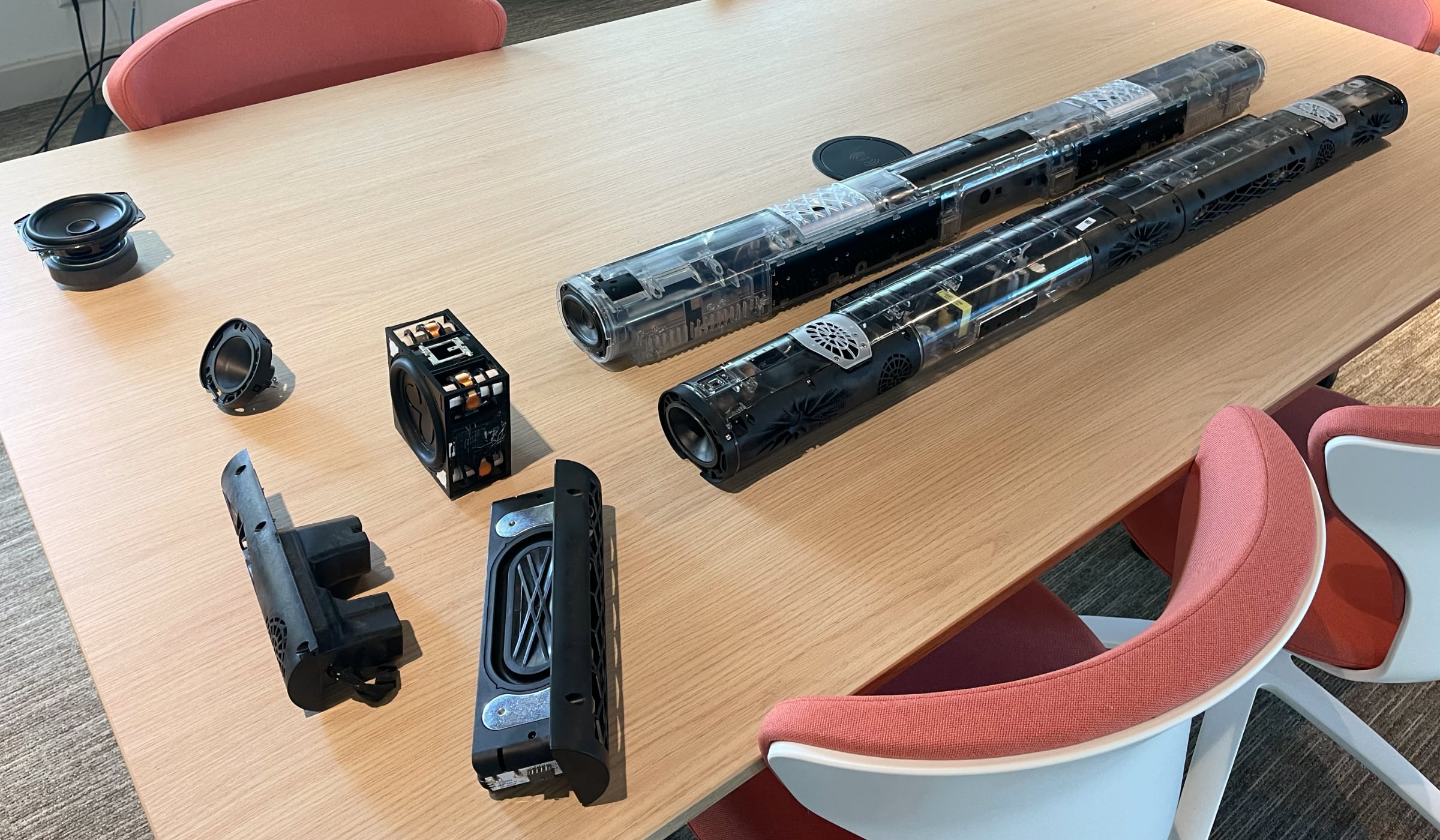
The Sound Motion unit is what sets Sonos Arc Ultra apart from the original Arc. Photo: FlatpanelsHD
Sound Motion for bass
In 2022, Sonos acquired Dutch company Mayht for around $100 million dollars. According to Sonos, the neodymium magnet technology is one of the biggest breakthroughs in audio engineering in nearly a century.
The technology has been named Sound Motion and is a new way of creating a bass unit that is both powerful and compact. It is the secret behind the deep bass in the Sonos Arc Ultra soundbar, but the company hinted that the technology may appear in other products in the near future. It os not a subwoofer – Sonos still sells those separately – but a unit for low and mid-bass frequencies.
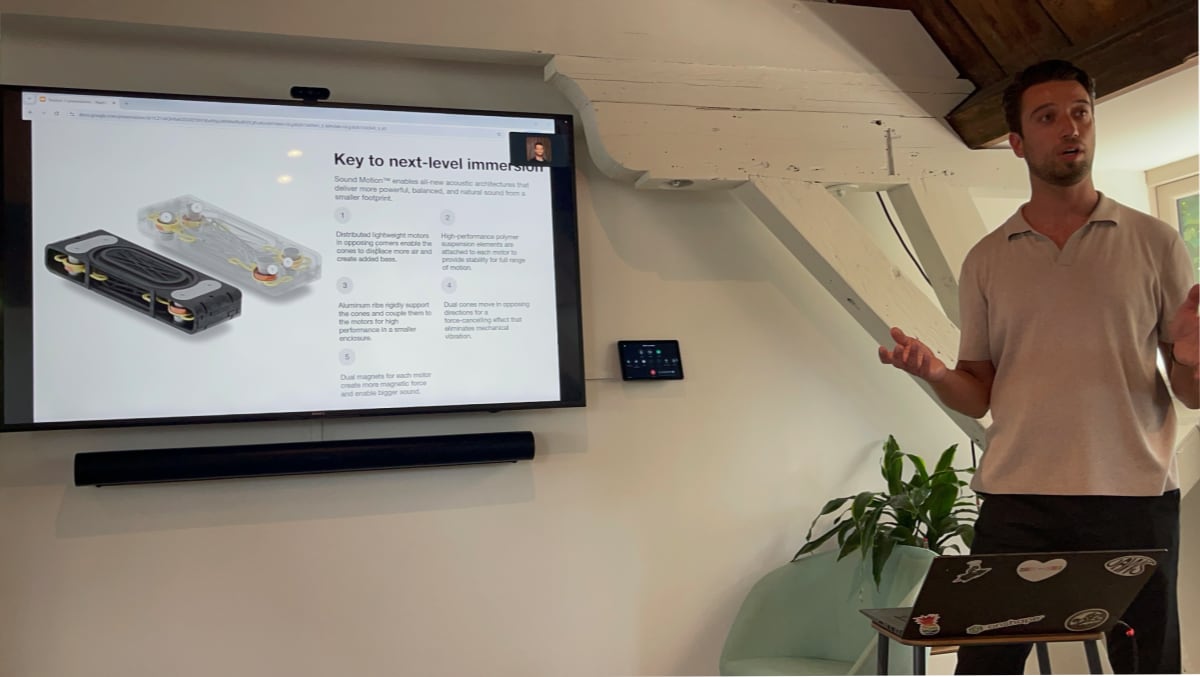
Sonos believes Sound Motion has big potential. Photo: FlatpanelsHD
Although Sonos declined to talk about future plans, it is clear they believe they are onto something big. Instead of the traditional cone shape, the Sound Motion unit in Arc Ultra is elliptical and produces bass like this:
The odd light effect is due to the video being shot under strobe lighting to capture the motion of the unit.
We already described what Sound Motion brings to the Sonos Arc Ultra in our review of Sonos Arc Ultra.
The technology differs differently from the bass unit in the older Sonos Arc and to give you an introduction we recorded the presentation by the Sonos employees who originally developed the technology at Mayht:
Improved speech enhancement
A new feature that arrived after our Arc Ultra review is speech enhancement powered by machine learning, commonly referred to as "AI". There are now four levels (Low, Medium, High, Max), with Medium offering a balance and Max aimed at people with hearing loss.
You will probably agree that traditional approaches to voice enhancement have never been great. These typically work by simply boosting the center channel or the frequency range where voices tend to sit. The issue is that neither the center channel nor that frequency range contains only voices, so you also amplify unwanted noise, which defeats the purpose.
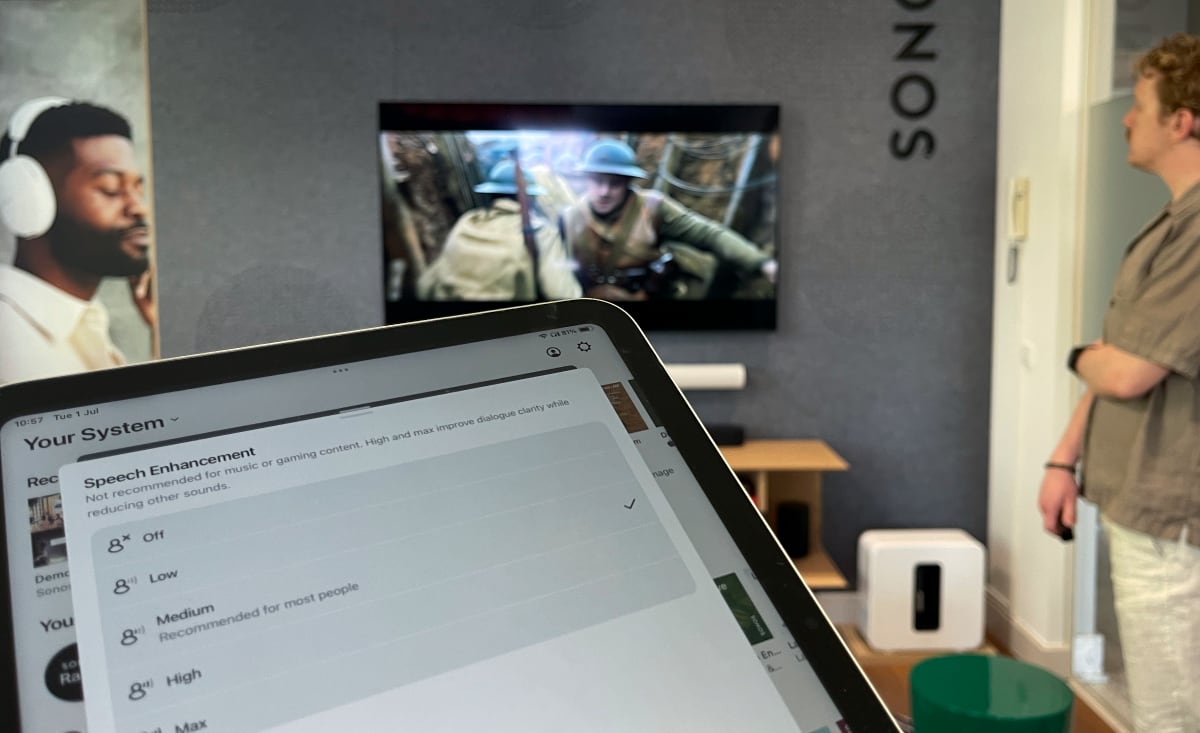
Speech Enhancement is controlled via the Sonos app. Photo: FlatpanelsHD
Like some other manufacturers, Sonos now uses a new algorithm, trained on machine learning, to isolate voices from the rest of the sound mix. Only the voices you want to hear – not the café background noise. We have seen similar approaches from Apple, Samsung, and Sony.
In our experience, Sonos' Medium level is particularly effective. It strikes a good balance between keeping movie sound cinematic while making dialog more intelligible. The Low level feels a bit redundant and the High level starts to affect the rest of the audio too much.
We encourage Sonos to bring this improved voice enhancement to its other soundbars as well. It is currently limited to Arc Ultra.
The UK's RNID (Royal National Institute for Deaf People) was involved in the development, which is reflected in the Max setting, but the collaboration also helped shape the feature more generally, as explained by Sonos in the video below.
Spatial audio and TrueCinema
In June, Sonos released a major update for its headphones, Ace, adding four new features: Personal Home Theater for Two, TrueCinema, improved noise cancellation, and SideTone. The last two mainly relate to music and voice calls, so let us focus on the first two for movie sound.
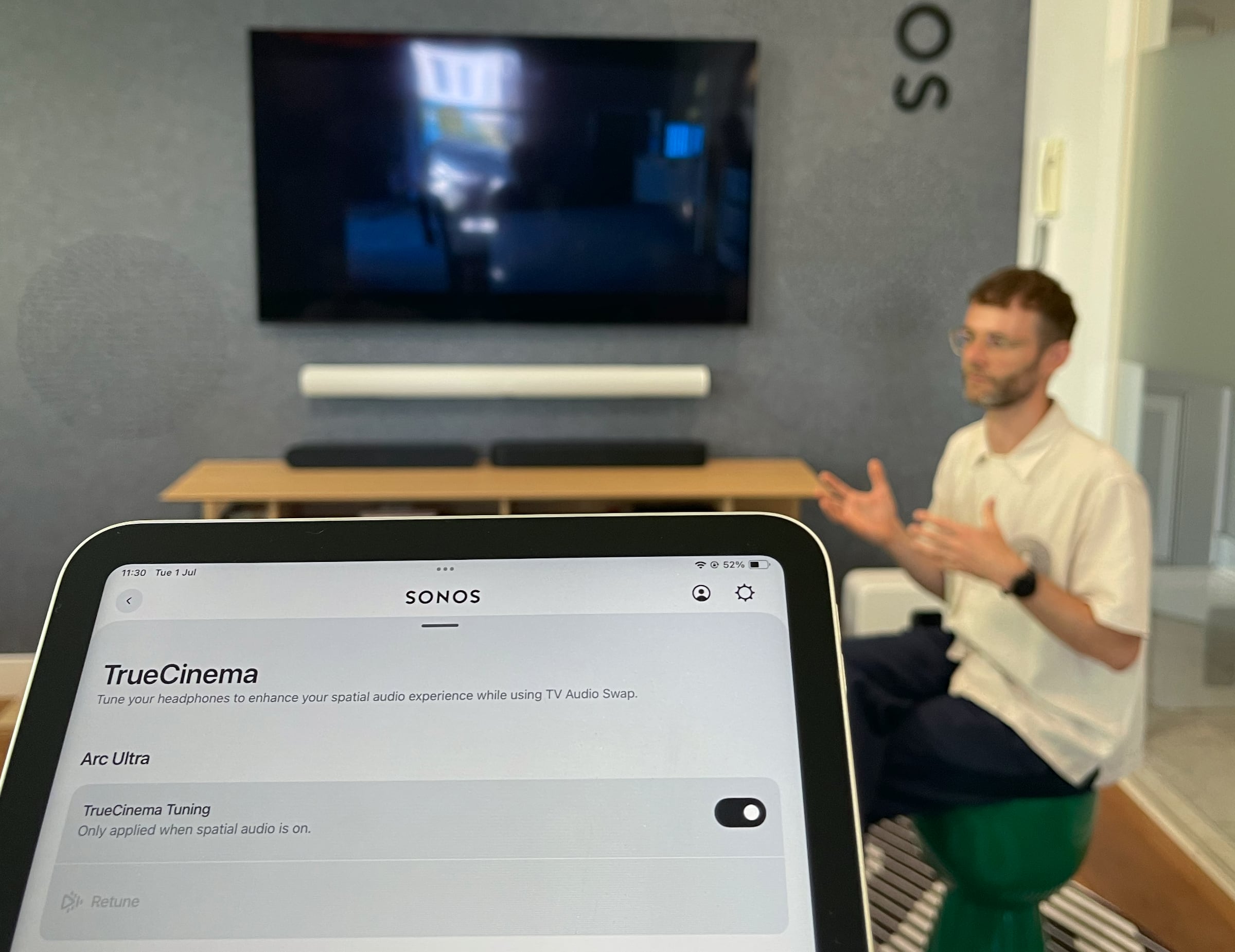
TrueCinema is an extension of spatial audio. The idea is that Ace headphones should not only expand the soundstage significantly (spatial audio), but also take the room's acoustics into account.
Here, we were less convinced. In the movie scenes selected by Sonos, we often had trouble hearing any difference with TrueCinema on or off. We were not alone. However, it is worth noting that, unsurprisingly, Sonos' demo room was already acoustically optimized. We have also tried TrueCinema in a typical European living room, where it opens up the sound a bit more, but it is still a very subtle effect
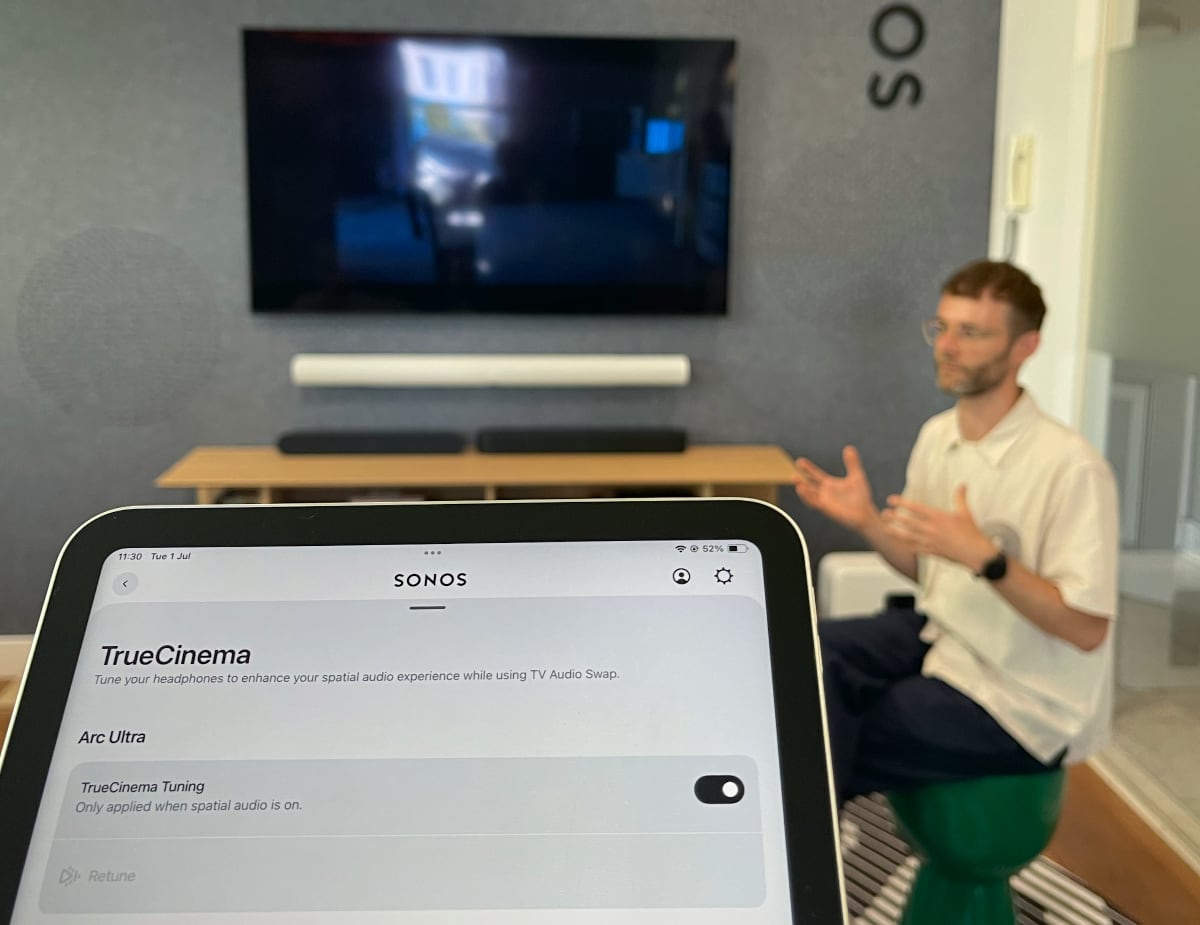
TrueCinema is controlled via the Sonos app. Photo: FlatpanelsHD
What makes the real difference is spatial audio itself – where the headphones receive a Dolby Atmos or 5.1 audio track from the soundbar and make it sound like you are sitting in a room full of speakers. The sound seemingly detaches from the headphones, making dialog sound as if it is coming from the TV, and effects from around the room. If you own Ace and a Sonos soundbar, you should try it. In our view, Sonos is one of the two leaders in this area, not counting gaming.
The direct competitor here is Apple with its AirPods spatial audio. In our opinion Apple's effect is slightly better, but Sonos still performs well. Sonos' advantage is compatibility with all audio sources, including HDMI-connected players and game consoles. That is because the Sonos soundbar is the "brain" of the system, whereas for Apple, Apple TV 4K plays that role, meaning that for AirPods it does not work with, for example, game consoles.
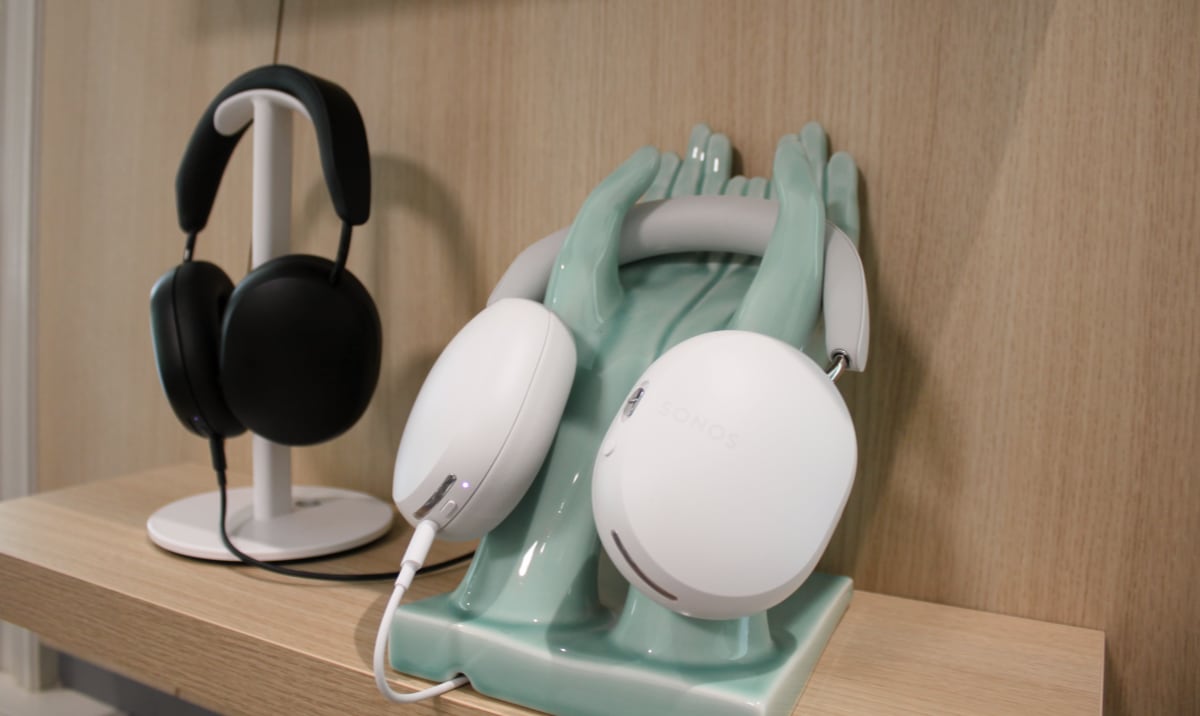
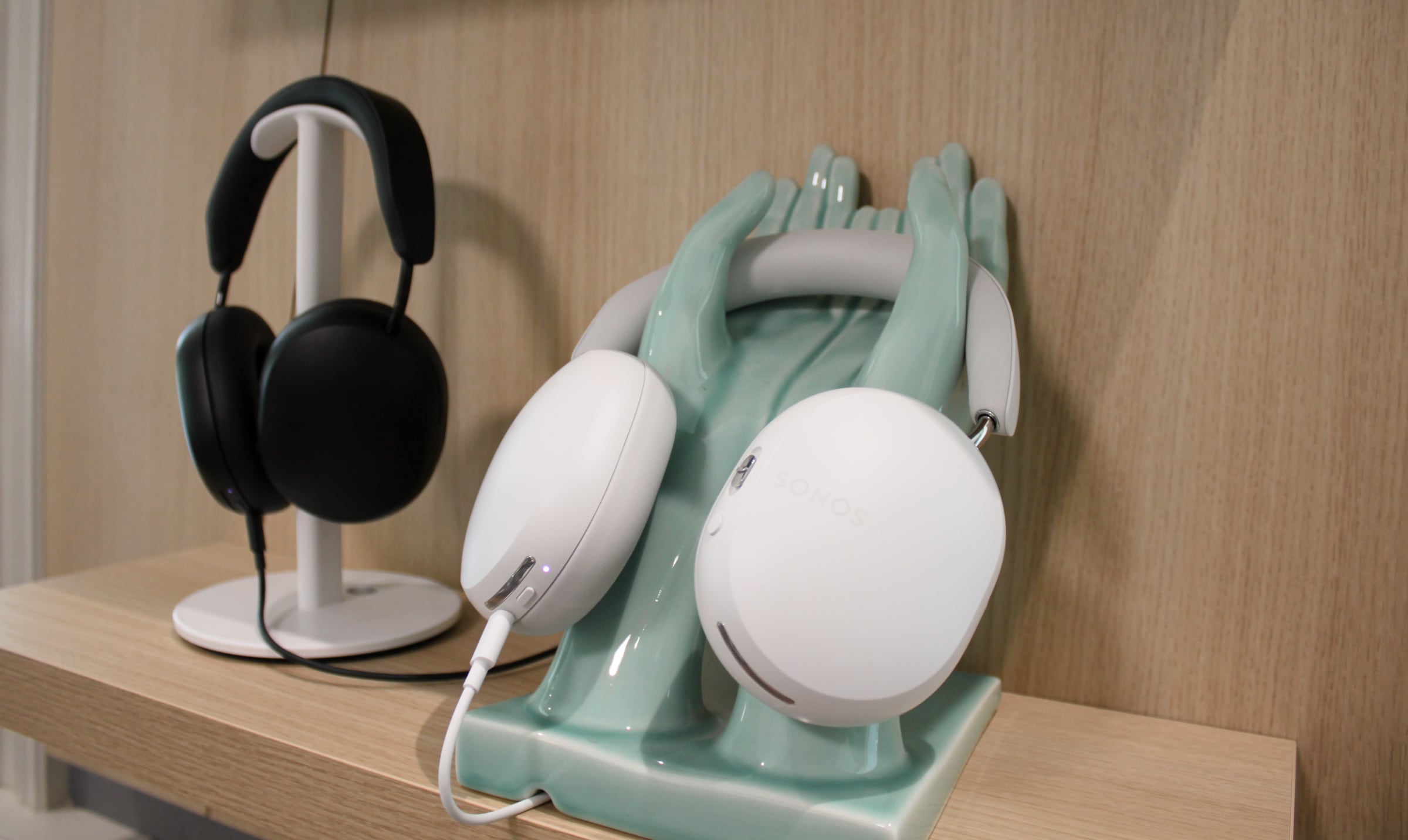
Personal Home Theater for Two gives you cinematic sound at home without having to fill your living room with speakers – but without subwoofer bass. Photo: FlatpanelsHD
Home theater for two
With the Personal Home Theater for Two feature, you can now get spatial audio in two Ace headsets simultaneously, for when two people want full cinematic or gaming sound while the kids are asleep, or if you just do not have a surround system at home. Previously, only one Ace headset could be connected at once.
It still works very well with two sets of Ace, but no longer with head-tracking. That means the dialog from the movie no longer stays fixed at the TV's position, but moves with your head. We missed that a bit.
Sonos did not rule out that it could work in the future, as the connection to Ace runs over WiFi – not Bluetooth – and the soundbar handles the processing – not the Ace headphones – but the initial focus has been on reliability, it said. We got the same answer when asking about the possibility of connecting more than two sets of Ace simultaneously.
If you want to dive deeper into how the systems are designed, we also recorded Sonos' presentation of the new features for Ace.