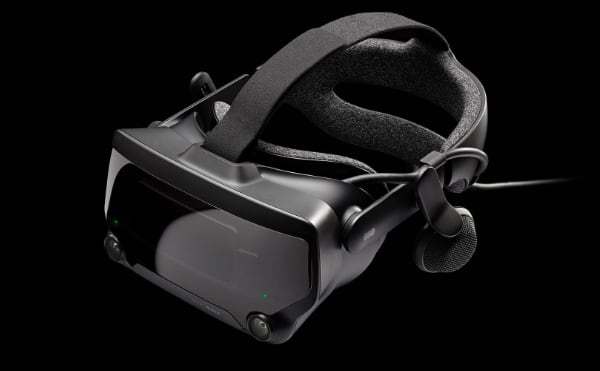
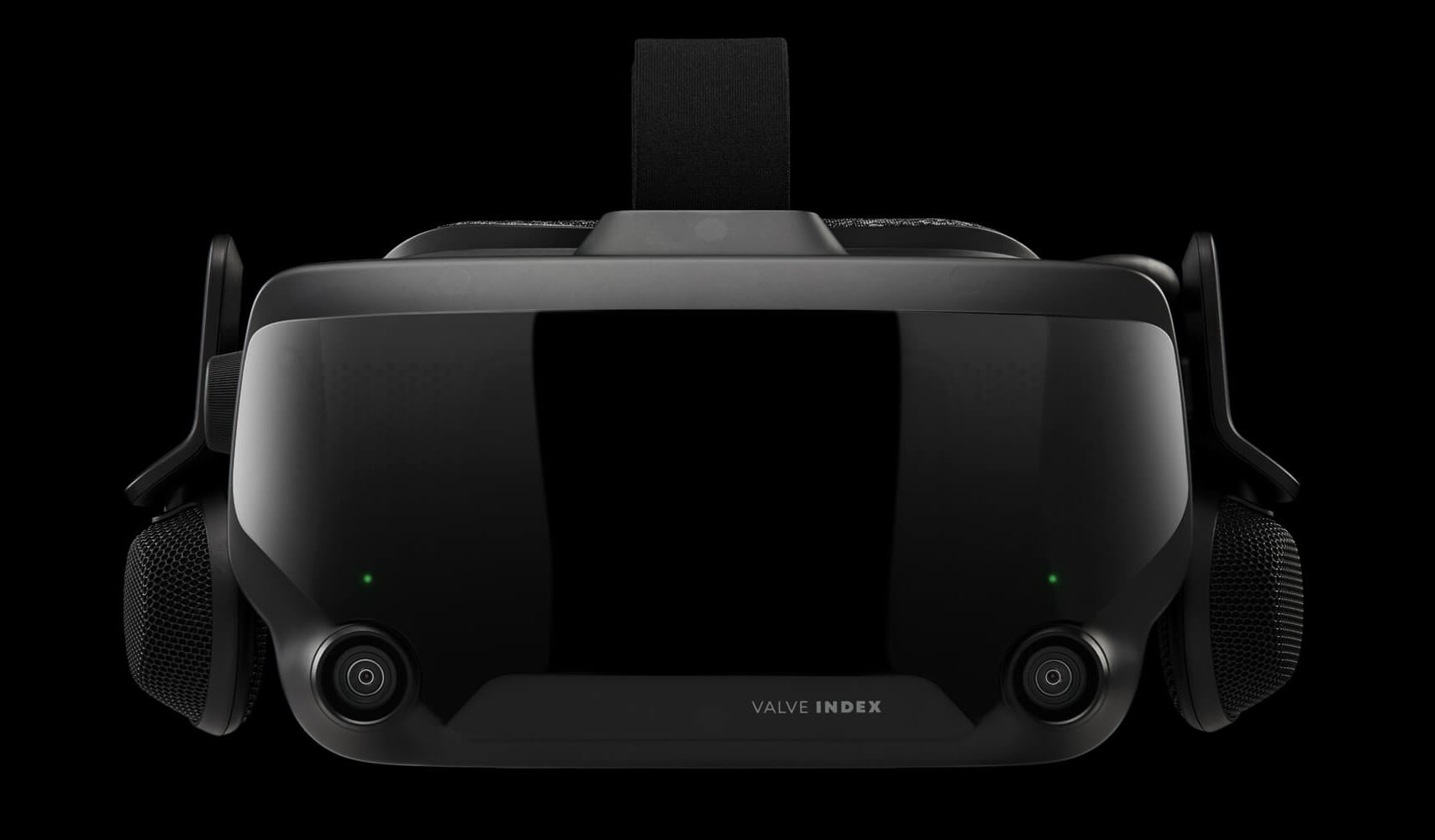
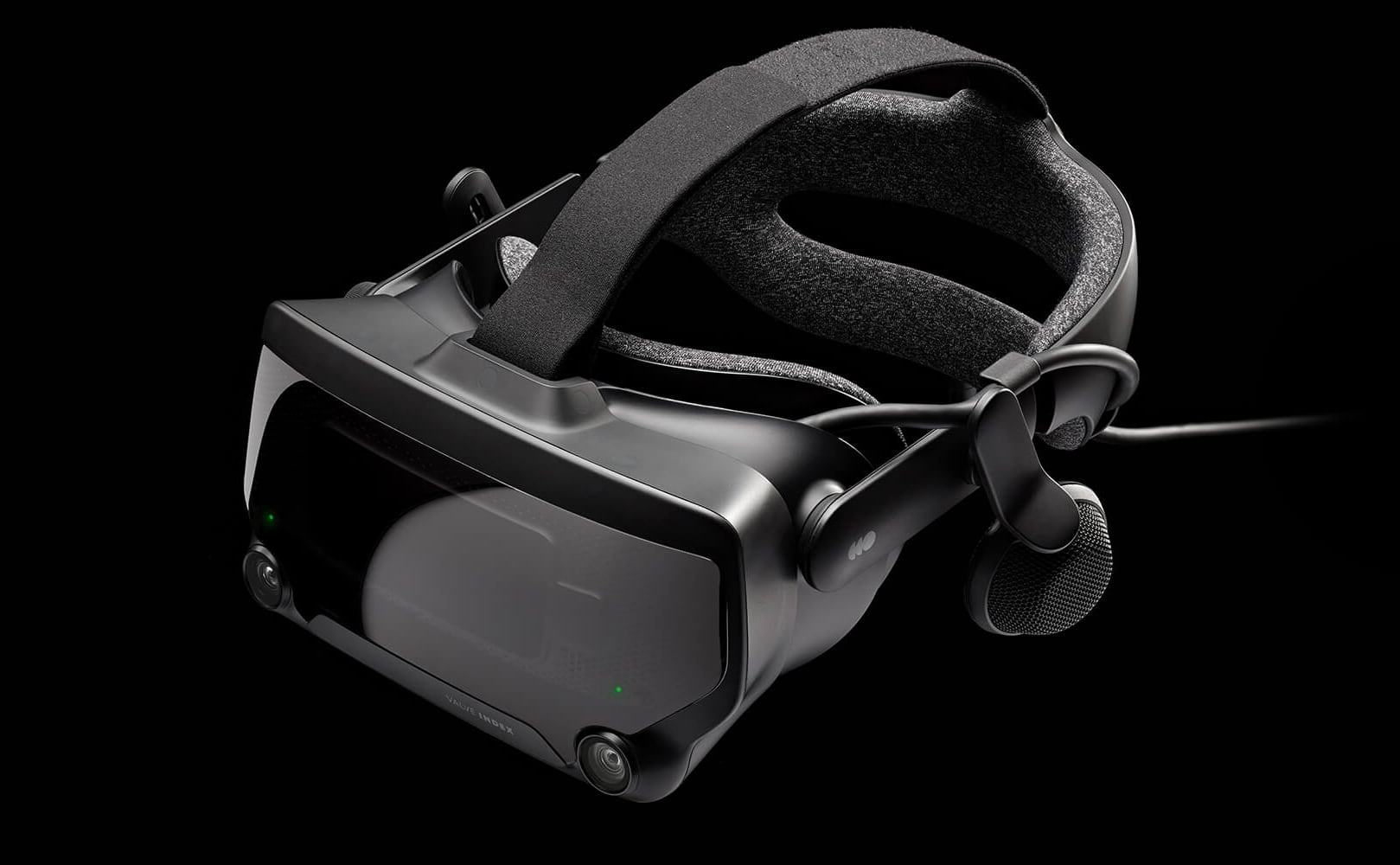
Valve has unveiled its own virtual reality headset. The Index VR has dual RGB LCD displays and up to 144Hz frame rate. The full kit is priced at $999 / €1079.
Valve Index VR headset
Valve has previously partnered with HTC for the HTC Vive headset but with the new headset, Valve is putting its own name on the box. The company's new Index VR headset is the next step for the PC-tethered VR experience.
The headset uses dual LCD screens with RGB pixels rather than the OLED screens found in many other high-end VR headsets. Valve argues that the "dual 1440x1600 RGB LCDs provide 50% more subpixels than OLED, resulting in greater sharpness for the same rendering cost" and that higher resolution reduces the screen door effect.

The headset runs at 120Hz, with an experimental 144Hz mode, says Valve. The displays also have very low persistence for great motion. The company claims a "5x improvement over first-generation PC VR HMDs".
Like the HTC Vive, Valve's Index VR is a tethered headset that must be connected to a gaming PC via a cable. It has built-in speakers and cameras but still relies on the external base stations for room tracking.
Since Valve appears to be taking more control of VR development and commercialization, one would probably expect it to have at least one major game in development. It may have but there is no news on those plans just yet.

Valve's Index VR will compete with VR headsets mainly from Facebook's Oculus who appears more focused on bringing VR to a wider audience. Valve says that, with Index VR, it set out to "push visual, audio, and ergonomic technologies to create the best-in-class VR experience".
The Index VR is available for pre-order now and will start shipping in late June 2019. The headset is available separately for $499 / €539, if you already have controllers and base stations, or as a full kit for $999 / €1079. More information can be found on valvesoftware.com.
Valve Index VR - specifications
Displays
Dual 1440 x 1600 LCDs, full RGB per pixel, ultra-low persistence global backlight illumination (0.330ms at 144Hz)
Framerate
80/90/120/144Hz
Optics
Double element, canted lens design
Field of View (FOV)
Optimized eye relief adjustment allows a typical user experience 20ş more than the HTC Vive
Inter-pupillary Distance (IPD)
58mm - 70mm range physical adjustment
Ergonomic Adjustments
Head size, eye relief (FOV), IPD, speaker positions. Rear cradle adapter included.
Connections
5m tether, 1m breakaway trident connector. USB 3.0, DisplayPort 1.2, 12V power
Tracking
SteamVR 2.0 sensors, compatible with SteamVR 1.0 and 2.0 base stations
Audio
Built-in: 37.5mm off-ear Balanced Mode Radiators (BMR), Frequency Response: 40Hz - 24KHz, Impedance: 6 Ohm, SPL: 98.96 dBSPL at 1cm.
Aux Headphone Out 3.5mm
Microphone
Dual Microphone Array, Frequency response: 20Hz – 24kHz, Sensitivity: -25dBFS/Pa @ 1kHz
Cameras
Stereo 960 x 960 pixel, global shutter, RGB (Bayer)
|