Los Angeles-based startup Q-Pixel claims that it has not only created the world's first full-color microLED display with ultra-high resolution, but also solved decades-old problems.
A 55-inch 4K display has a pixel density of 80 ppi (pixels per inch) while a 55-inch 8K display reaches 160 ppi.
The microLED announced by the stealth startup company Q-Pixel has 5000 ppi.
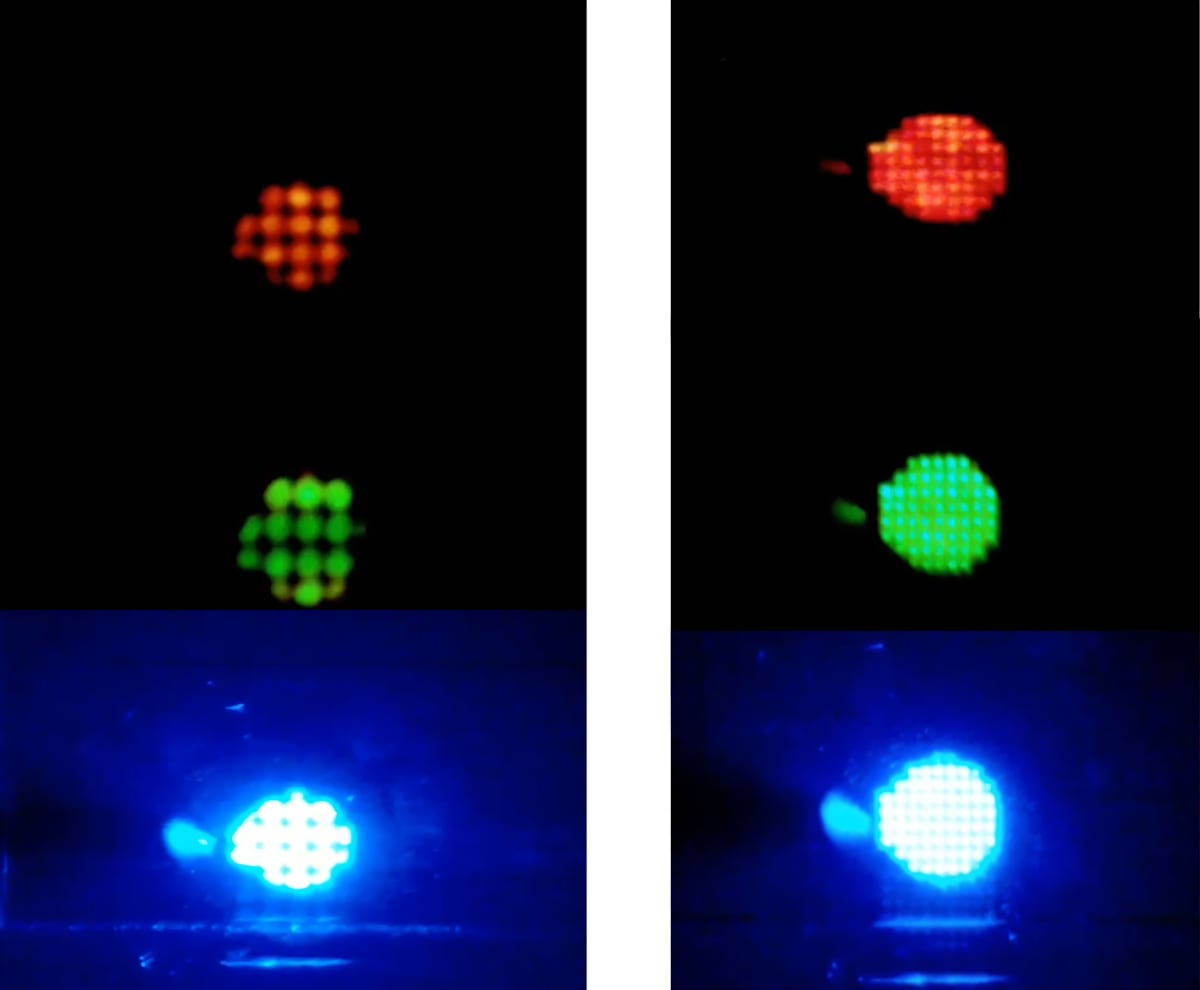
2300 ppi (left) and 5000 ppi (right). 45-um diameter circles containing full-color pixels with different sizes (4 and 10 um). Photo: Q-Pixel
- "(Q-Pixel Inc.) announces the world's first full-color, ultra-high resolution microLED display, establishing a groundbreaking new milestone in the display industry. For the first time, using their proprietary Polychromatic microLED technology, Q-Pixel has achieved full-color LED display with a world record-breaking pixel density of 5000 pixels per inch (PPI), surpassing the current world record of 2000 PPI held by ITRI of Taiwan. Q-Pixel's revolutionary new technology is a game-changer to the display industry," the company announced in May.
While such high resolution is unnecessary for TVs, it could help advance VR/MR/AR headsets and other types of products. For comparison Apple's Vision Pro headset's micro-OLED – not microLED – is estimated to have approximately 3400 ppi.
Solves decades-long challenges
In the last two decades, full-color LEDs have not seen much improvement in mainstream applications, which is largely due to the manufacturing constraints of assembling individual red, green, and blue LEDs, according to Q-Pixel.
The company believes that its approach has solved the issues and that the breakthrough may accelerate mass-production of microLED displays.
- "Q-Pixel's proprietary Polychromatic microLED technology introduces full-color tunability across a single 4-micron pixel, replacing the century-old single-color LED and addressing several decades-long challenges to the microdisplay industry. Q-Pixel's tunable, full-color single-pixel LED eliminates the need for pick-and-place (a key bottleneck in traditional LED display assembly), while at the same time enabling ultra-high pixel density," the company said.
Promising if true but let's see. We are still waiting for the microLED TVs that Samsung first announced in 2018.