OLED displays could soon become significantly more energy-efficient if Samsung Display achieves its goal of reducing power consumption by over 50%.
The plan was announced last week at the IMID 2024 conference in South Korea, according to Korean newspaper The Elec. Samsung Display – the display panel maker – aims to accomplish this reduction while preserving the excellent picture quality of today's OLED panels.
- "Samsung Display is aiming to reduce the power consumption of its display panels by over 50%," reported The Elec. "The display panel maker was developing technologies that remove all factors that influence power consumption in its display, Samsung Display executive vice president Yi Chung said during an industry conference in Jeju, South Korea."
Longer lifespan, higher brightness
Following its decision in June 2022 to wholly abandon LCD technology, Samsung Display now focuses exclusively on OLED panels.
Reducing OLED power consumption is a key driver for improving picture quality, as it leads to cooler operation and an extended lifespan. Improved energy efficiency can also be exchanged for higher brightness.
In mobile devices, it can also extend battery life, which appears to be a key motivational factor for Samsung Display, which supplies OLED panels to major brands such as Samsung Electronics and Apple.
How to get there
Samsung Display has already developed OLED panels without an external polarizer film (to prevent reflecting external light), including QD-OLED as well as 'Eco-OLED' for mobile devices, which reduce power consumption by 25%. Removing the external polarizer is a key component of their new plan.
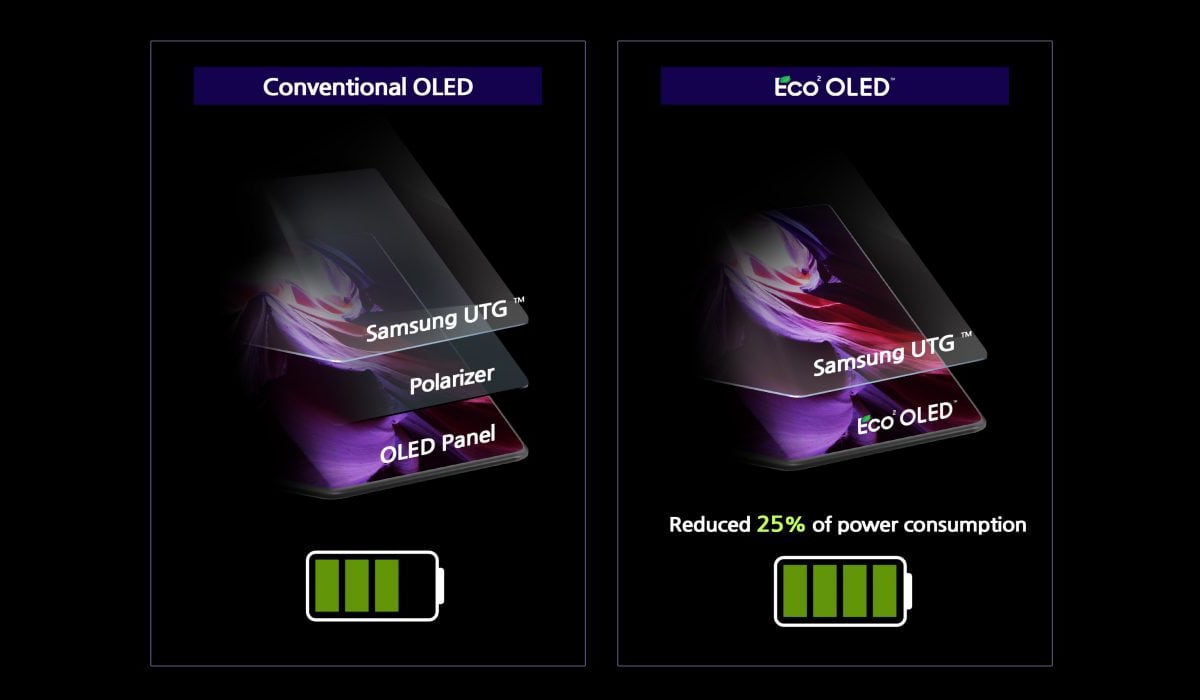
In 2021, Samsung unveiled 'Eco-OLED' without an external polarizer film, but it is just one of several enhancements planned. Photo: Samsung Display
Another component is "multi-frequency driving", which is an evolution of variable refresh rate technology, where different parts of the display – for example, moving and still areas – are driven at different refresh rates (Hz).
A third component involves using tandem OLED designs with two or more emissive layers to further improve efficiency, according to the company.
A fourth component could be to switch to blue PHOLED, as LG Display has just announced.
However, Samsung Display has not provided a timeline for when it expects to achieve its goal.
- Source: The Elec