LG Display is investing nearly 1 billion dollars in next-gen OLED and in addition to the technologies outlined in our previous article, the company will also explore 'eLEAP' production.
Developed by Japan Display Inc. (JDI), eLEAP stands for environment positive, Lithography with maskless deposition, Extreme long life, low power, and high luminance, Any shape Patterning.
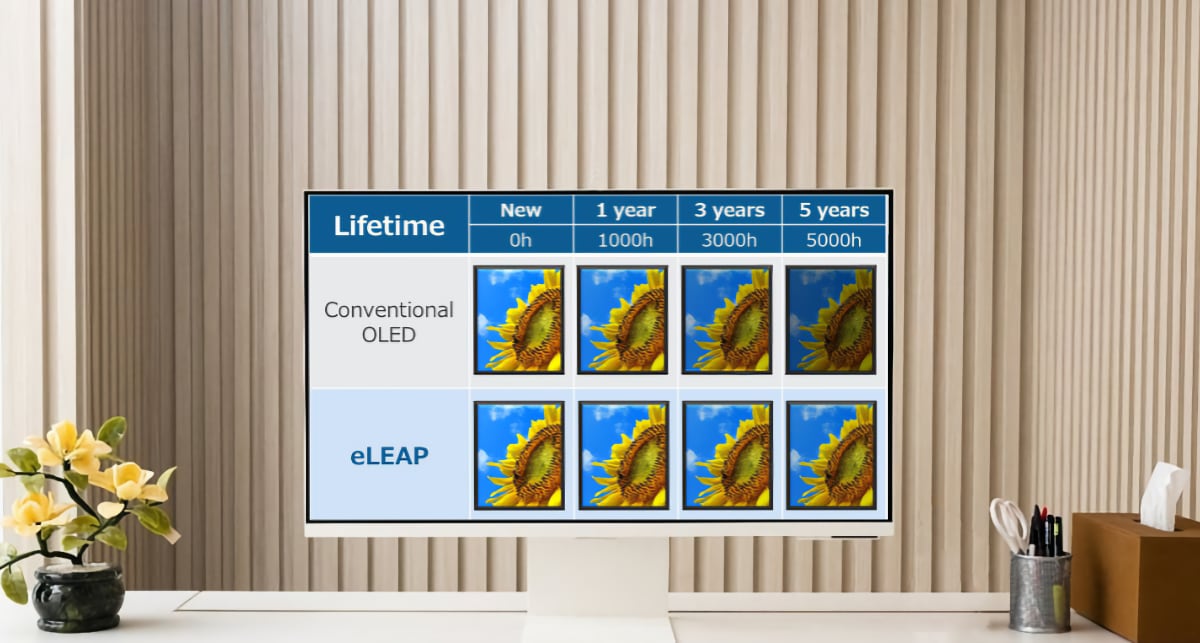
In simpler terms, eLEAP enables OLED material to be deposited without using fine metal masks (FMM). This allows for a much larger aperture ratio (60% compared to around 30%) resulting in twice the efficiency, twice the peak brightness, and up to three times the lifetime. With a tandem structure, eLEAP can achieve brightness levels exceeding 3000 nits.
LG Display to evaluate eLEAP
eLEAP has been in development for years. While Japan Display began small-scale production in late 2024, the panels have yet to appear in mainstream consumer products. Japan Display is seeking a partner to help scale up mass production.
According to Korean newspaper The Elec, LG Display now plans to test eLEAP for RGB OLED panels at its existing E4 production line in Paju, South Korea.
Apparently LG Display can utilize its current production equipment with some modifications. However, the company is not yet ready to commit to full-scale investment, and initially the technology would be used for niche OLED panels in the 20- and 30-inch segments.

Source: JDI
LG Display is not alone
While Japan Display has been the main driver behind eLEAP, other companies are involved, too.
In late 2024, reports suggested a connection to Applied Materials' new 'Max OLED' manufacturing platform, which Samsung Display plans to use for producing improved RGB OLED panels for smartphones, tablets, laptops, monitors, and possibly even TVs.
China's Visionox is also moving forward with its own “ViP” maskless OLED production, using the production machines from Applied Materials.
- Source: The Elec