Netflix is leading the charge in the transition to the AV1 video codec for improved video quality at lower bandwidth with less buffering. The company has provided a status update.
- "Since entering the streaming business in 2007, Netflix has primarily relied on H.264/AVC as its streaming format. However, we quickly recognized that a modern, open codec would benefit not only Netflix, but the entire multimedia industry," the company said in a new blog post.
While Netflix initially settled on HEVC as the successor to MPEG4 AVC, its focus has since shifted to AV1, which has hit a milestone as we near the end of 2025.
- "Today, AV1 accounts for approximately 30% of all Netflix streaming, making it our second most-used codec – and it’s on track to become number one very soon. The payoff has been substantial."
Better video quality, less buffering
The company explained that on TVs, its AV1 video streams outperform both MPEG4 AVC and HEVC in quality evaluations (see table at the bottom) while using one-third less bandwidth on average. There are 45% fewer buffering interruptions.
AV1 also helps deliver cinematic film grain in movies and series using a technique called Film Grain Synthesis (FGS) that strips out the grain during video encoding and adds it back during decoding, Netflix explained, saving bandwidth and improving video quality.
 The same (cropped) frame from source (left), regular AV1 stream encoded at 8274kbps (middle) and AV1 FGS stream encoded at 2804 kbps (right). The AV1 FGS stream reduces the bitrate by 66% while delivering clearly better quality. Photo: Netflix
Netflix' AV1 rollout
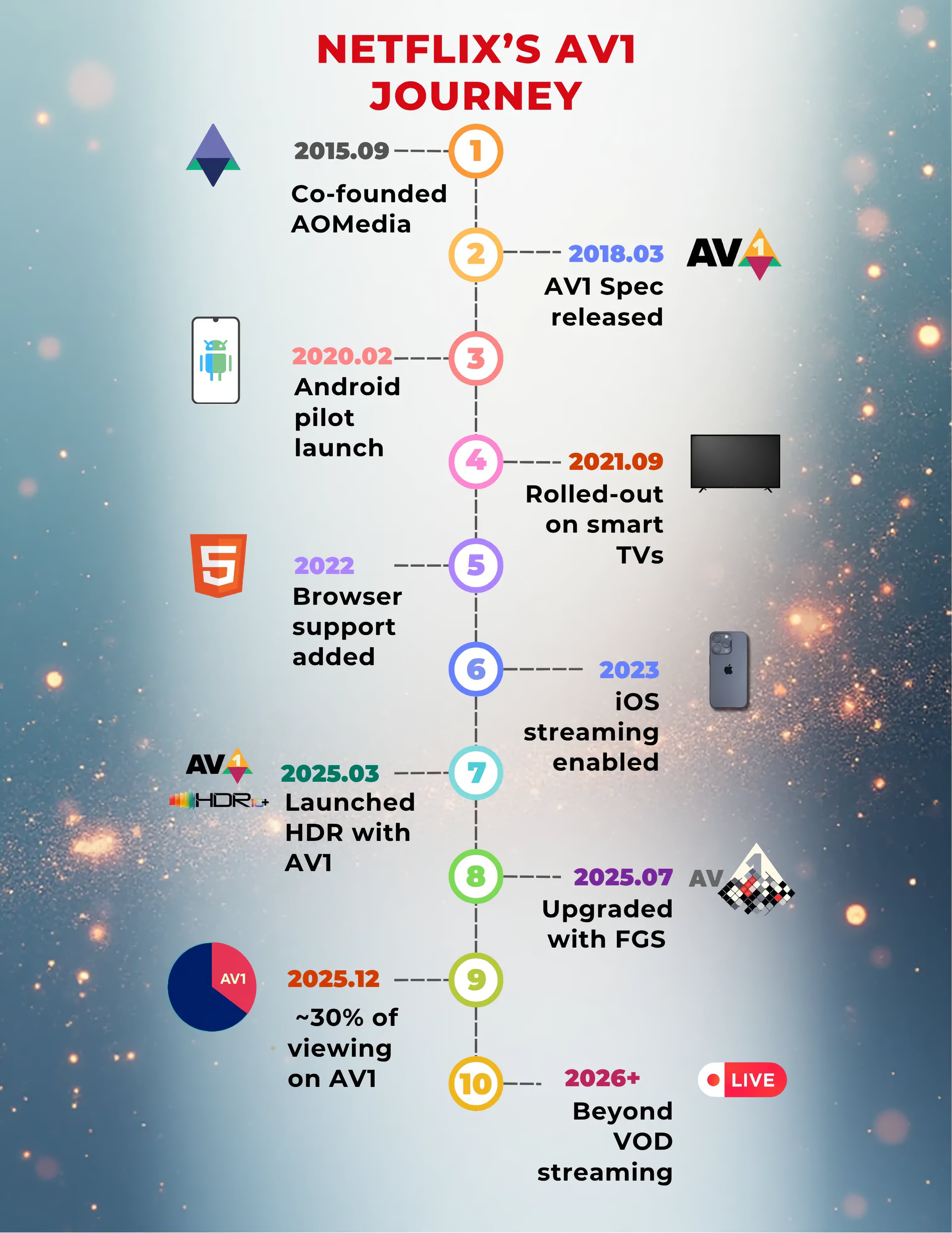
Netflix is one of two major streamers to have embraced AV1, the other being YouTube. FlatpanelsHD has reported on the rollout, starting with the company's launch of AV1 streaming in February 2020.
AV1 support from Netflix began rolling out on TV devices in late 2021 (only SDR) and web browser support was added in 2022. Netflix also highlighted that Apple added AV1 hardware-accelerated decoding in 2023 with the M3 and A17 Pro chips. In March 2025, Netflix finally began using AV1 for HDR streaming, specifically HDR10+ to Samsung TVs, which do not support Dolby Vision.
Also read: Google, Netflix & YouTube to require AV1 video decoding support
AV1 support in TV devices
Most Smart TVs now support AV1 in hardware. Newer handheld devices do too, but game consoles, media players and PCs lag behind.
- "Over the past five years (2021–2025), 88% of large-screen devices, including TVs, set-top boxes, and streaming sticks, submitted for Netflix certification have supported AV1, with the vast majority offering full 4K@60fps capability. Notably, since 2023, almost all devices we have received for certification are AV1-capable," said Netflix
The recently launched Google TV Streamer supports AV1. The next Apple TV 4K will support AV1 if it is powered by the A17 Pro chip or newer. There are currently no credible rumors about an upgraded Nvidia Shield.
Also read: Anyone can now grade movies in up to 32K resolution
AV1 for live sport and gaming
Netflix said that it is actively evaluating AV1 for live streaming, including sports events such as football, tennis and boxing, to help reduce buffering.
In addition, Netflix confirms that it has concrete plans to use AV1 for cloud gaming, or game streaming, to enable a "high-quality, low-latency gaming experience across a wide range of devices". Think GTA without the need for a console.
As for the 70% of streams not powered by AV1, some of the challenges lie in hardware support (most older devices will never support AV1) and HDR10 and Dolby Vision streaming.
Netflix commits to AV2, sort of
With AV1 already improving the streaming quality for hundreds of millions of streamers worldwide, Netflix said that AV2 is "poised to set a new benchmark".
Netflix strongly hinted that it is planning to use AV2 but it did not provide any timeline or details, only saying that "while AV2 represents the future of streaming, AV1 is very much the present". The company does not appear to have plans to use VVC, the official successor to HEVC.
Also read: VVC (H.266) video codec effectively dead on arrival, posits analyst
AV2 will be released later this year. No TVs or media players with support for AV2 have been announced yet.
AV1 advantages for Netflix
|
In the company's own words:
Elevating Streaming Experience Across the Board:
Large-screen TVs and other devices demand higher bitrates to deliver stunning 4K, high frame rate (HFR) experiences. AV1’s superior compression efficiency has allowed us to provide these experiences using less data, making high-quality streaming more accessible and reliable. On average, AV1 streaming sessions achieve VMAF scores¹ that are 4.3 points higher than AVC and 0.9 points higher than HEVC sessions. At the same time, AV1 sessions use one-third less bandwidth than both AVC and HEVC, resulting in 45% fewer buffering interruptions. Moreover, Netflix’s diverse content catalog benefits universally from AV1, with improvements across all content types.
Driving Network Efficiency Worldwide:
Netflix streams are delivered through our own content delivery network (Open Connect), in partnership with local ISPs around the globe. With more than 300 million members, Netflix streaming constitutes a non-trivial portion of global internet traffic. Because AV1 is a more efficient codec, its streams are smaller in size (while providing even better visual quality). By shifting a substantial share of our streaming to AV1, we reduce overall internet bandwidth consumption, and lessen system and network load for both Netflix and our partners.
Update on HDR10+ with AV1
As anticipated, the combination of AV1 and HDR10+ allows us to deliver images with greater detail, more vibrant colors, and an overall heightened sense of immersion for our members. At the moment, 85% of our HDR catalog (from the perspective of view-hours) has AV1-HDR10+ coverage, and this number is expected to reach 100% in the next couple of months.
Cinematic Film Grain
Film grain is a hallmark of the cinematic experience, widely used in the movie industry to enhance a film’s depth, texture, and realism. However, because film grain is inherently random, faithfully representing it in digital video requires a significant amount of data. This presents a unique challenge for streaming: restricting the bitrate can result in grain that appears unnatural or distorted, while increasing the bitrate to accurately preserve cinematic grain almost inevitably leads to elevated rebuffering. The AV1 specification incorporates a unique solution called Film Grain Synthesis (FGS). Instead of encoding grain as part of every frame, the grain is stripped out before encoding and then resynthesized at the decoder using parameters sent in the bitstream, delivering a realistic cinematic film grain experience without the usual data costs.
This approach represents a significant shift from traditional compression and streaming techniques. Our team invested substantial effort in fine-tuning the media processing pipeline, ensuring FGS delivers robust performance at scale. In July 2025, we successfully productized AV1 FGS, and the results were astonishing: AV1 with FGS could deliver videos with cinematic film grain at a bitrate well within the capabilities of typical household internet connections. For non-FGS AV1 encodings, even at much higher bitrate, they may not be able to achieve comparable quality. |
FlatpanelsHD