In a declining overall theatrical market, cinemagoers are increasingly opting for big experiences, as evidenced by IMAX's record year in 2025, surpassing 2019 before covid.
From mainly documentary features in museums and planetariums to the biggest Hollywood tentpoles.
It was not until the early 2000s that Hollywood films began releasing in IMAX but today IMAX has transformed into one of the most popular premium large formats (PLF) for cinemas. IMAX competes with other PLFs such as Dolby Cinema, Cinity and Epic, with the PLF market projected to more than double by 2033.
Record year
IMAX has confirmed that it had a record year in 2025 with $1.28 billion grossed worldwide, up 40% versus 2024 and up 13% versus the former record in 2019 just before covid-19. It represents 3.8% of the global box office.
- "2025 was truly a transformational year for IMAX in which we leveled up our performance across our business – capturing a greater share of total box office with a wider variety of releases across an expanding global footprint," said Rich Gelfond, CEO of IMAX. "We see no signs of slowing down given a very promising slate ahead and the consistency of our market share gains, as filmmakers, studios, and audiences worldwide continue to gravitate toward the IMAX Experience."
The company said that 122 titles were shown in some form of IMAX in 2025 – also a record. The top-grossing title was China's Ne Zha 2, underlining how popular IMAX is in China.
IMAX fragmentation
IMAX continues to expand, but only a handful of its 1,800 screens worldwide are what fans consider true IMAX with huge screens, mainly 70mm IMAX GT (Grand Theatre) – fewer than 40 screens – or to some extent 'IMAX with Laser GT' with digital laser projectors. These can project in the expansive 1.43 aspect ratio.
Many of the other screens are IMAX Digital with 2K resolution and small screens, sometimes referred to as 'LieMAX', or single laser projectors with 4K resolution. These project in the 1.90:1 aspect ratio.
IMAX projectors also support 3D. The company has not commented on plans to adopt modular LED screens, like Samsung's Onyx, which opens the door to HDR cinema.
Also read: Only 100 cinemas can show 'Inside Out 2' as Pixar intended
IMAX has also launched the 'IMAX Enhanced' initiative for home entertainment, with Disney+ as the leading partner. However, these titles are presented in the still expansive but smaller 1.90:1 aspect ratio.
 IMAX 1.43:1 vs. 1.90:11 vs. standard 2.39:1. Illustration: IMAX
Major releases in 2026
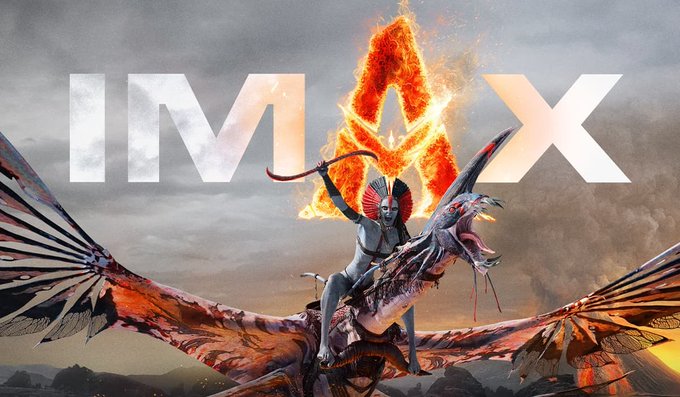
IMAX is projecting further growth to $1.4 billion in 2026, with major releases from the likes of Christopher Nolan and Denis Villeneuve confirmed, in addition to James Cameron's Avatar: Fire and Ash, released very late in 2025.
12 titles 'Filmed for IMAX' have been confirmed for 2026. These include The Odyssey, which is the first film shot entirely with IMAX film cameras, and Dune: Part Three, also shot on IMAX film cameras.
You can also look forward to titles such as Star Wars: The Mandalorian and Grogu and an exclusive 2-week release of Netflix's Narnia, a deal that has been criticized by competing theatrical exhibitors, in particular Vue, which has started closing IMAX auditoriums to operate its competing 'Epic' premium large format.
Top five IMAX filme software 2025
| - “Ne Zha 2” (Enlight) — $166.7 million
- “Avatar: Fire and Ash” (Disney/20th Century Studios) — $112 million
- “F1: The Movie” (Apple Films) — $97.6 million
- “Demon Slayer: Infinity Castle” (Toho) — $95.9 million
- “Mission: Impossible – The Final Reckoning” (Paramount) - $75.8 million |
FlatpanelsHD