The new approach advances light field technology to improve both 2D and 3D picture quality, while also widening the 3D viewing angle so multiple people can watch at the same time.
The joint project between Samsung Research, Samsung Electronics and Korea's Postech univertsity has been published in the peer-reviewed journal Nature under the title "Switchable 2D-3D display through a metasurface lenticular lens".
This stamp of approval suggests that it is a technology worth keeping an eye on.
Better 2D and 3D
The next-generation 3D system is still based on light field technology, the same principle used in Samsung's 27-inch Odyssey 3D G90XF and the upcoming 32-inch Odyssey 3D G90XH, both of which rely on an eye tracking camera.
However, the new approach uses ultra-thin 'metalenses' that can switch between concave and convex states using voltage. This allows the display to switch between high-resolution 2D and glasses-free 3D, while maintaining a thin form factor.
The system can deliver a 3D viewing angle of up to 100 degrees – significantly wider than today – while also improving overall pictures quality. Samsung refers to it as a breakthrough.
- "Though long considered promising for entertainment, augmented reality (AR) and medical imaging, conventional Light Field Displays face commercialization challenges, including bulky optics, narrow viewing angles (around 15 degrees), reduced resolution and reliance on real-time eye tracking. The research team addressed these limitations using polarization – the direction in which light oscillates – to design a metasurface lenticular lens (MLL) that dynamically adjusts focal properties," explained Samsung.
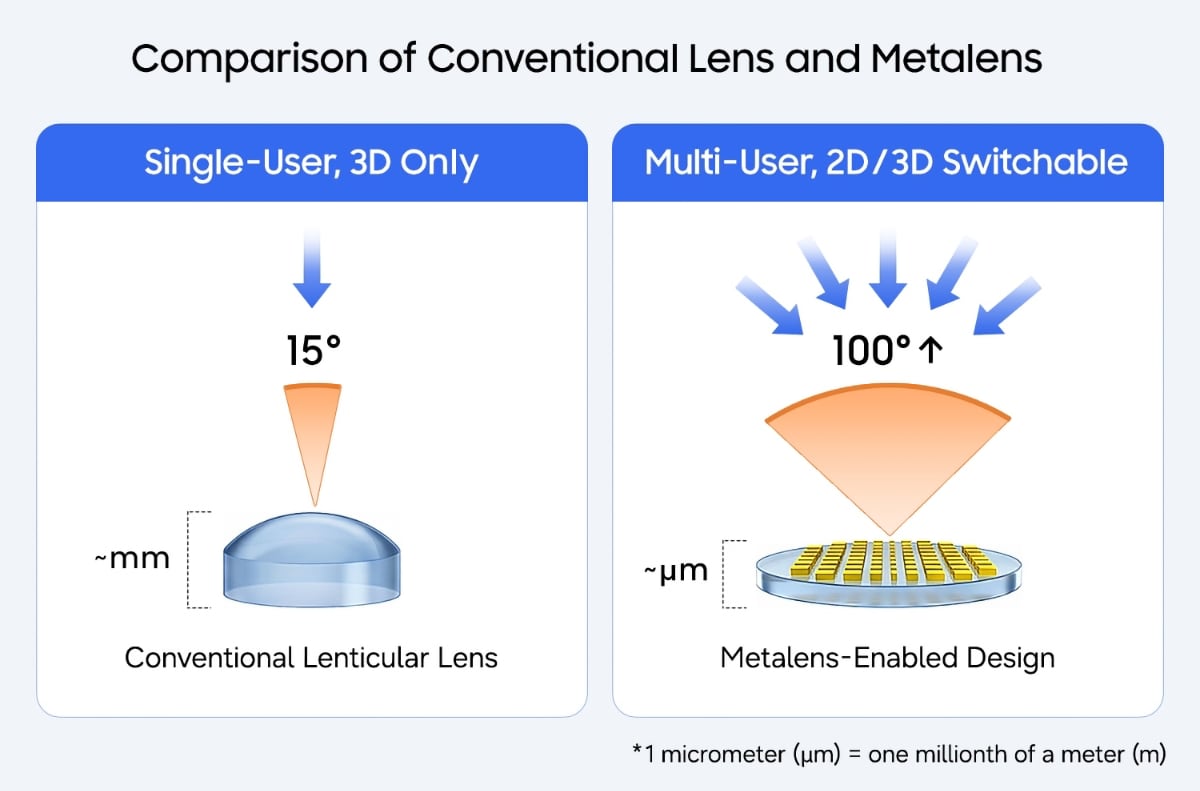 Prototype using metalens technology. Photo: Samsung
3D OLED incoming?
It is is not just a proof of concept. The company has developed a 50x50 mm metalens and integrated it with an OLED panel used in today's smartphones.
Samsung said that the technology "has the potential to reshape next-generation displays", though initial focus is on smartphones, tablets and commercial displays. Samsung did not provide a timeline and there is no word yet on 3D TVs
Also read: Samsung's 3D gaming revival aims for 120 games in 2026
The research is part of Samsung's broader effort to revive 3D – starting with gaming – using glasses-free technology, following earlier failed attempts based on 3D glasses.
- Source: Nature, Samsung