The new OLED panel uses one fewer layer, making it cheaper to produce while delivering better color and efficiency and comparable brightness, said LG Display.
We are getting cheaper 'OLED SE' panels this year in TVs from LG, Samsung, Panasonic, Philips and likely Sony too, but the new 2-stack panel unveiled by LG Display is a further evolution aimed at future displays.
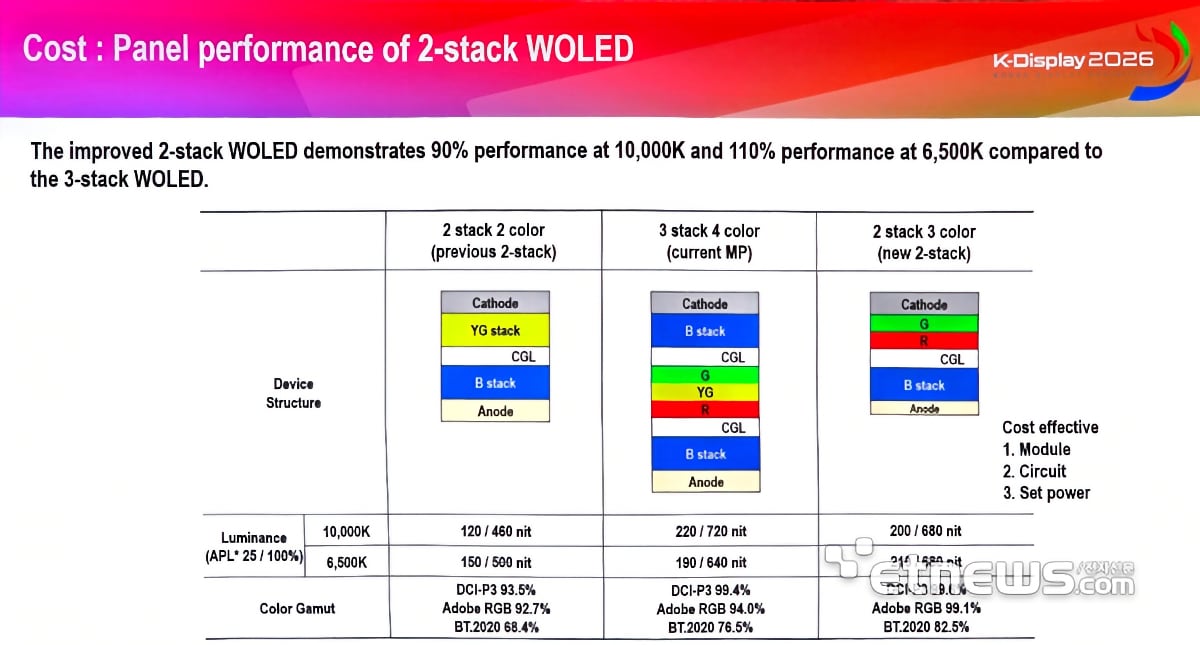
The key change is a new 2-layer OLED emitting structure instead of the 3-layer design used in current WOLED panels or the 4-layer structure found in high-end Tandem WOLED panels. According to LG Display, the new design will reduce production costs and improve energy efficiency while delivering comparable or better picture performance as well as an even wider viewing angle.
Improved BT.2020 color
According to the company, the new panel delivers 82.5% BT.2020 color coverage versus 76.5% BT.2020 on current 3-stack WOLED panels, representing a notable improvement in color performance.
It also delivers slightly higher brightness at a 6500 Kelvin color temperature, i.e. calibrated picture mode, but slightly lower brightness at higher color temperatures.
2013 WOLED (2-stack, 2-color) versus current WOLED (3-stack, 4-color) versus new WOLED (2-stack, 3-color). Photo: ETNews
For mid-range TVs and monitors
In statements to Korean newspaper The Elec and ETNews, LG Display explained that the new 2-stack WOLED panel has "adopted a new blue emissive material and replaced the conventional yellow-green emissive layer with separate red and green layers".
Also read: Is RGB LED a threat to OLED? How LG Display is pushing OLED forward
The new panel is intended for mid-range OLED TVs and monitors that will compete with miniLED LCD TVs, but LG Display has yet to confirm when it will be available to partners such as LG Electronics, Samsung, Sony, Philips, Panasonic, Asus, MSI and Dell.
- "If the next-generation two-stack architecture enters mass production, LG Display will be able to defend its position in the premium segment while expanding into the mid-range TV and monitor markets, where LCD and mini-LED technologies remain dominant," an industry source told The Elec.
- Source: ETNews, The Elec
Sign up for FlatpanelsHD's newsletter
The latest news, in-depth articles, reviews, and exclusives in your inbox.