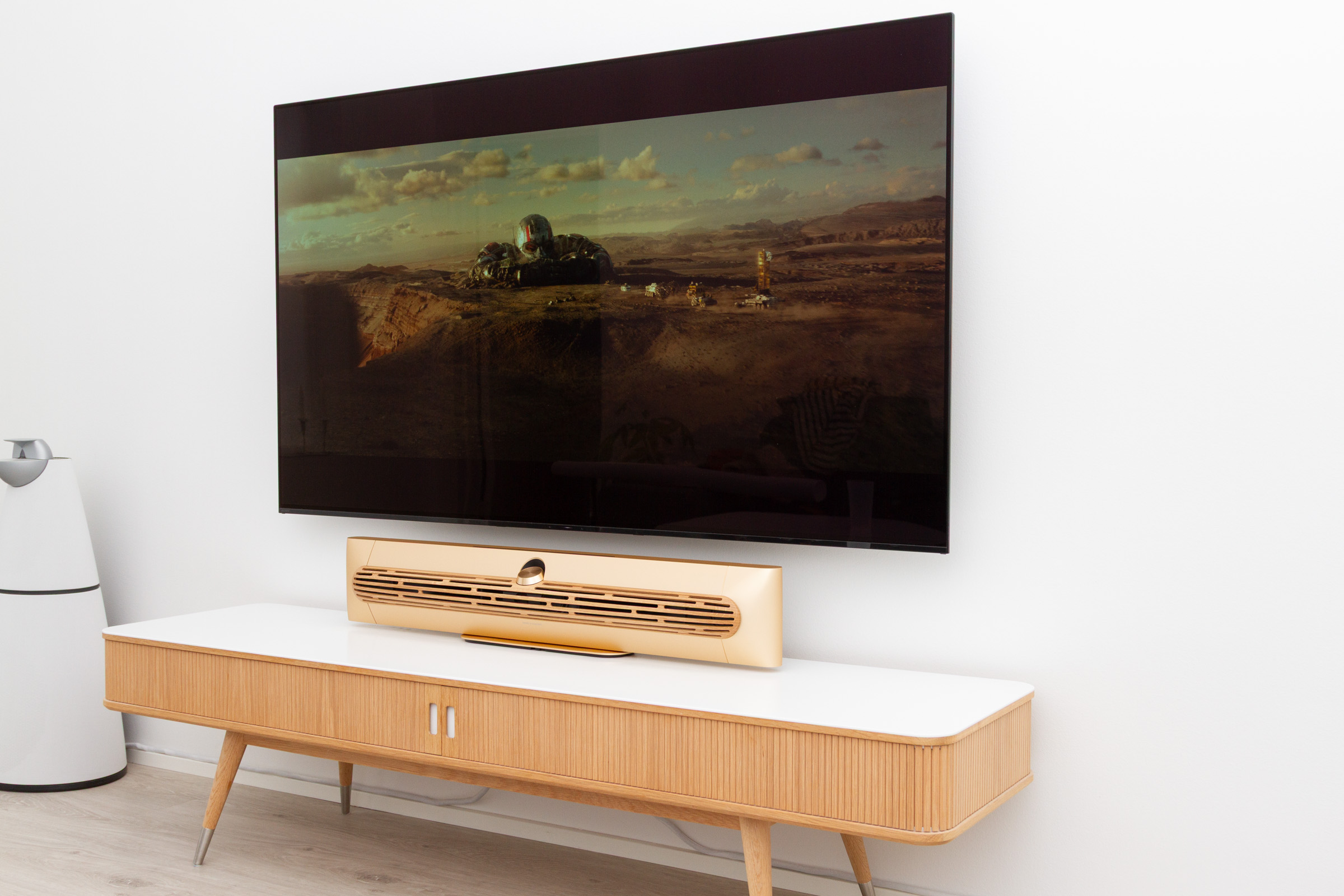
Bang & Olufsen's new "mid-range" soundbar, Beosound Premiere, slots in above Beosound Stage but well below Theatre in terms of price. It brings B&O's signature soundbar experience with support for expanding the speaker setup – to a certain extent – as well as integration with LG TVs for seamless control via B&O's own BeoRemote One.
Premiere is available in three color options, with a choice of three different front covers sold separately. We tested the so-called "Gold Tone" version fitted with the optional oak front cover.
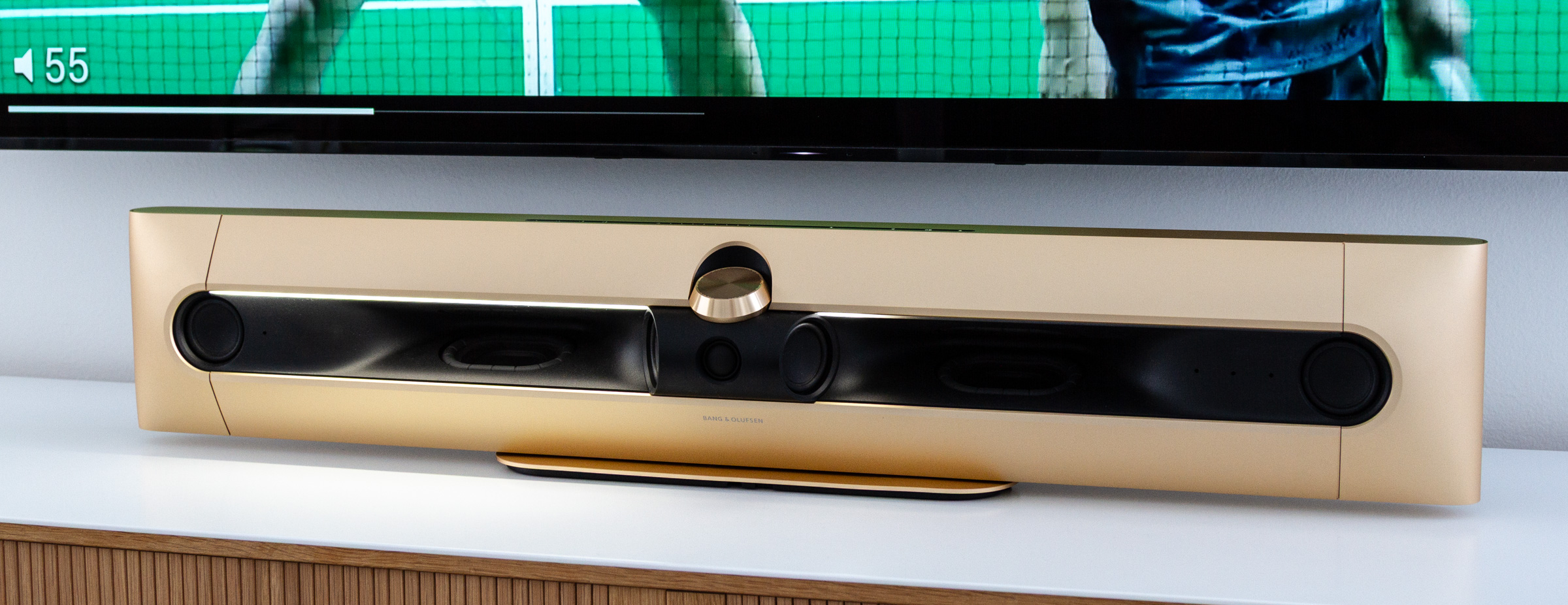
Bang & Olufsen has more or less perfected the art of making a strong first impression, and Beosound Premiere is no exception. Its matte bronze-colored aluminum body looks both premium and distinctive – a soundbar that doesn't try to disappear beneath the TV, but instead insists on being part of the room's décor. It carries the same design language we saw with both Beosound Theatre and Stage, and once again B&O demonstrates its mastery of aluminum craftsmanship. Note that all versions feature a matte finish, whereas many of the company's other speakers have a glossy surface unless you opt for the matte bead-blasted treatment.
Our review unit came with the optional oak front cover, and this is where the design feels slightly unbalanced. The wood doesn't quite harmonize with the Gold Tone finish, and it's easy to imagine it pairing much better with the black or silver versions, where the contrast is greater. The front cover is available in two wood finishes as well as a gray fabric option, which would probably have suited this particular version better. Personally, both my family and I preferred the look without the wooden cover altogether, although that minimalist appearance certainly won't appeal to everyone.
The stand, which doubles as both a tabletop stand and wall mount, is an elegant solution. The top plate, which is attached afterwards, is relatively thin, however, and our review sample arrived with a slight bend, likely the result of repeated handling during the review loan. It's worth treating it with care.
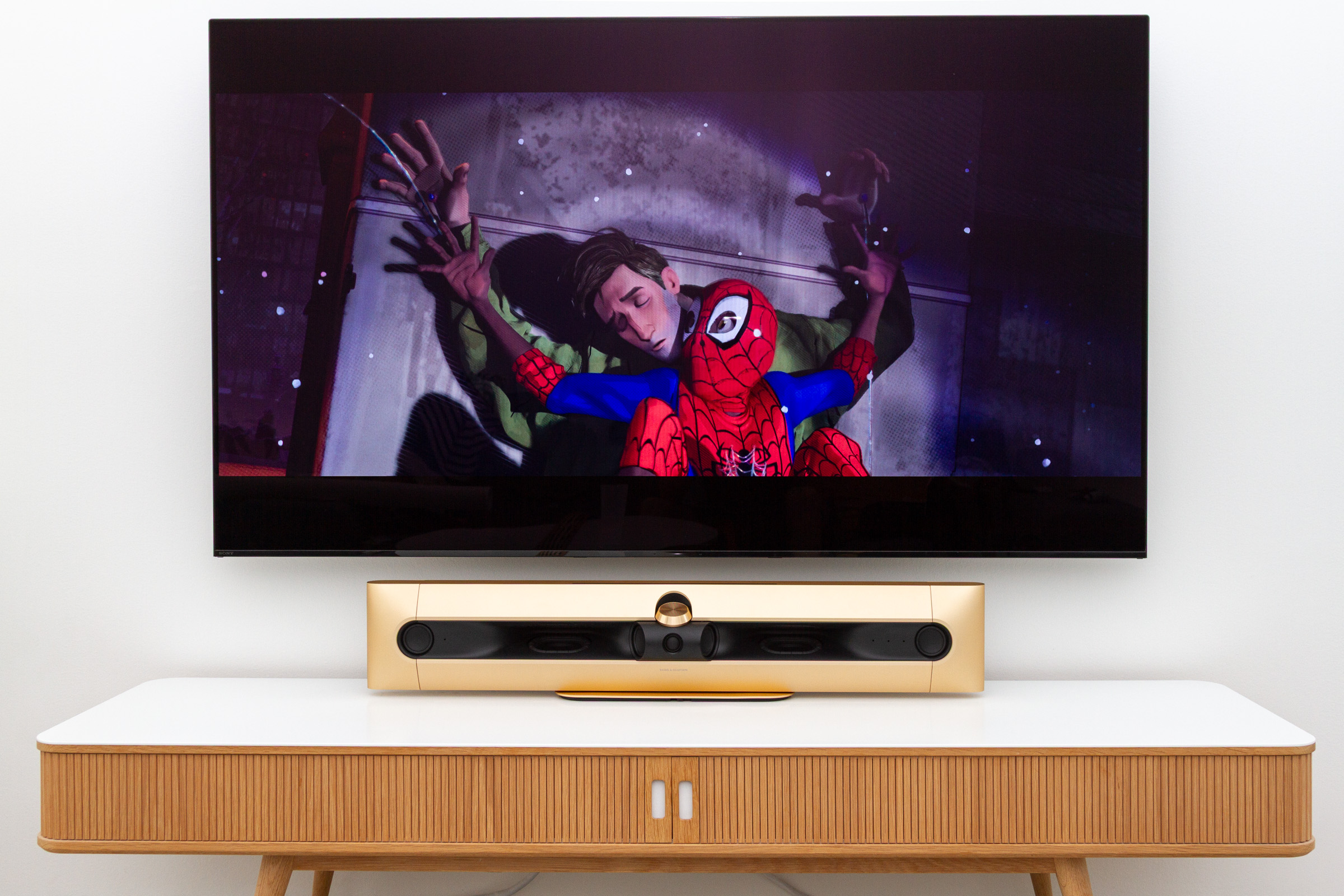
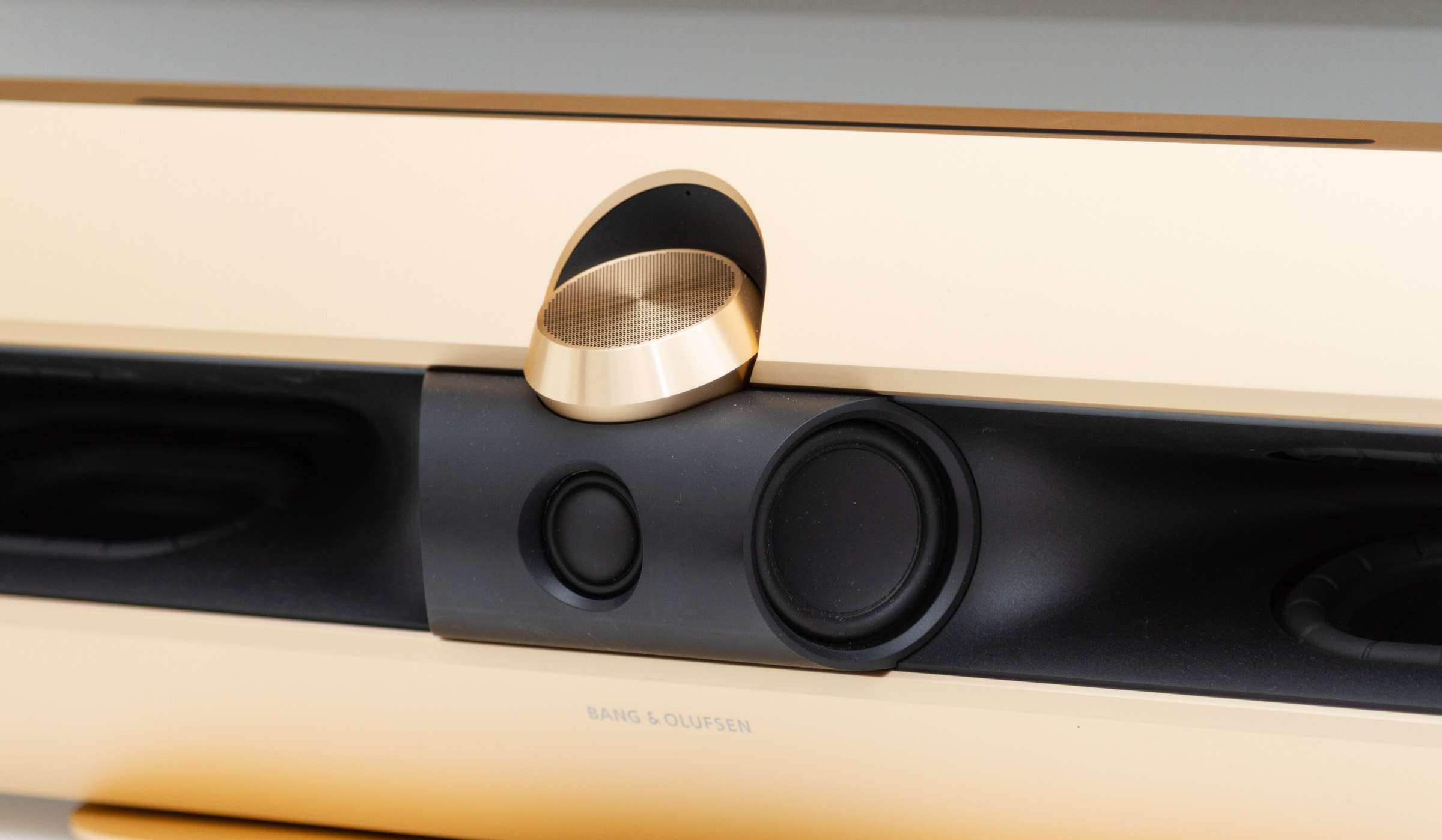
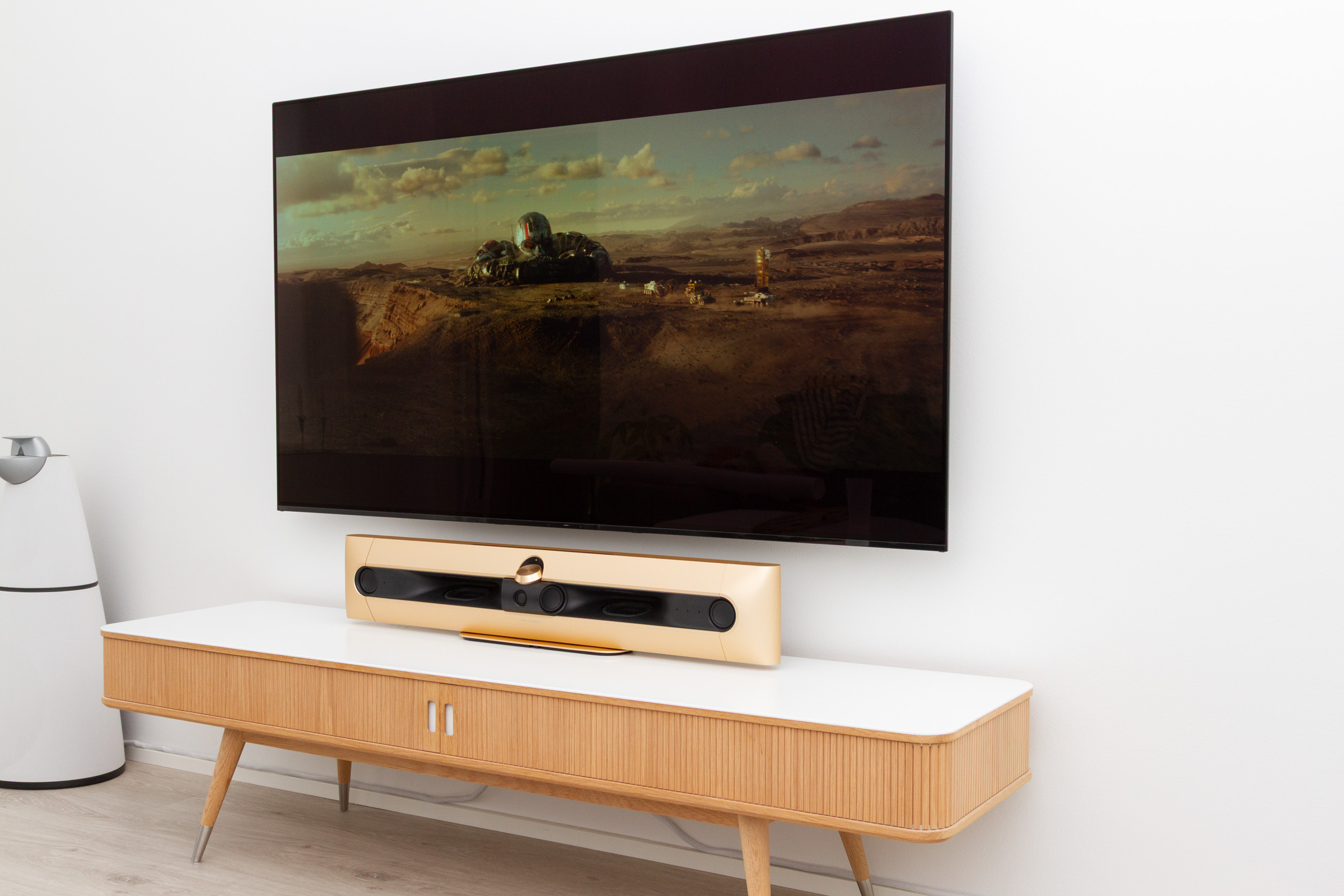
The design will undoubtedly divide opinion. The prominent central section, which houses the tweeter along with the upward- and side-firing drivers, gives Premiere a look unlike almost any other soundbar. You could almost describe it as sculptural, and it's a design that grows on you over time – but it certainly isn't trying to be discreet. Unlike Theatre, Premiere does not allow the TV to be mounted directly onto the soundbar, so make sure you have sufficient clearance beneath your TV. As shown in the photos, this wasn't an issue with my wall-mounted Sony AF9 OLED TV, although that's probably more a result of the height of my TV cabinet. I experienced the same slightly cramped appearance when we tested Theatre.
Looking at the speaker configuration, Premiere packs 10 drivers: a centrally mounted tweeter, one upward-firing driver concealed beneath the perforated grille, two front-firing full-range drivers, two side-firing full-range drivers (also located in the center section), and four woofers mounted at an angle inside the cut-out section of the enclosure. Each driver is powered by its own dedicated amplifier rated between 50 and 70 watts. Compared to Theatre, the specifications indicate that Premiere doesn't extend quite as deep into the bass, rolling off at 34Hz, whereas Theatre reaches slightly lower and can also deliver 8dB higher bass SPL.
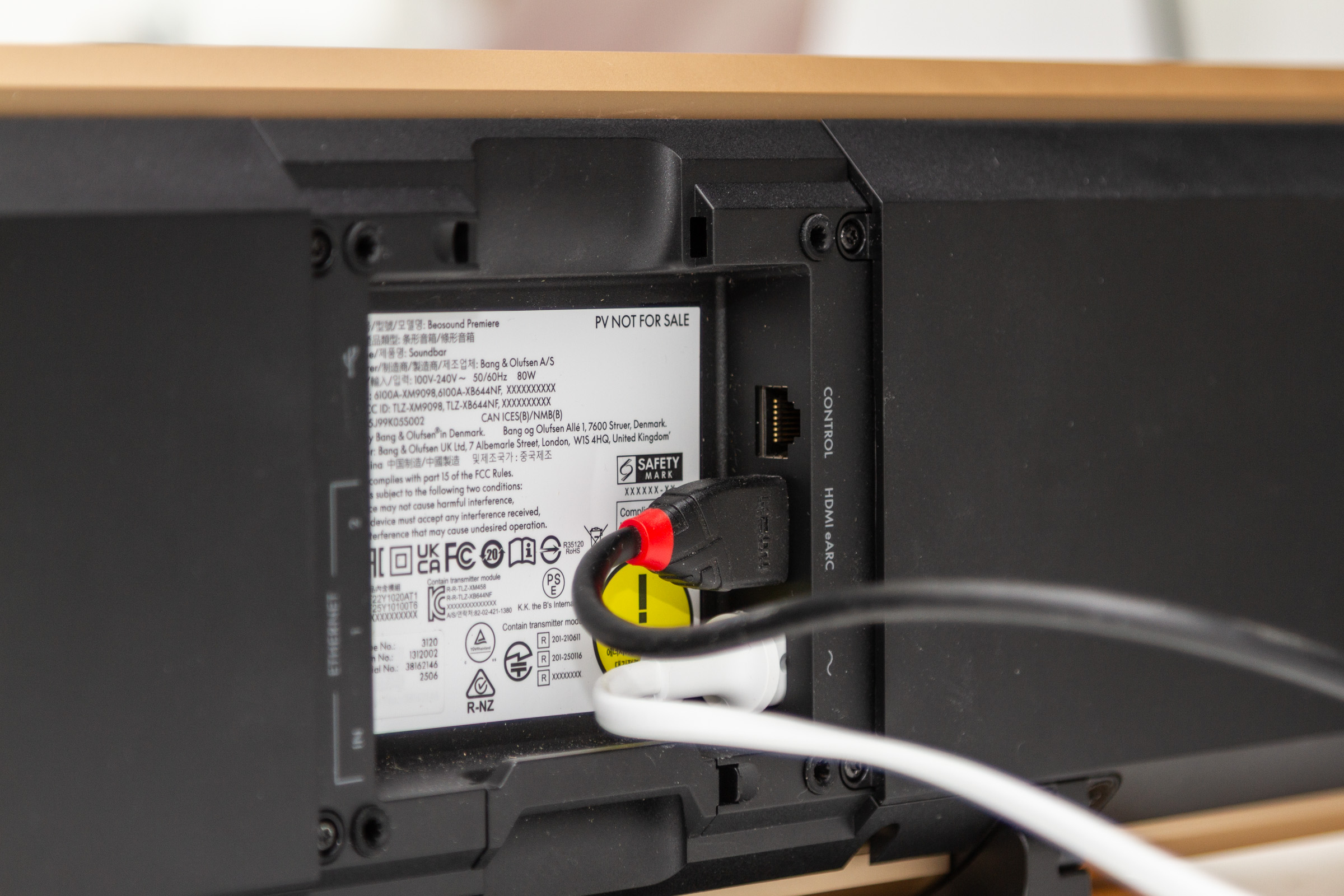
The rear panel of Beosound Premiere. Photo: Flatpanels
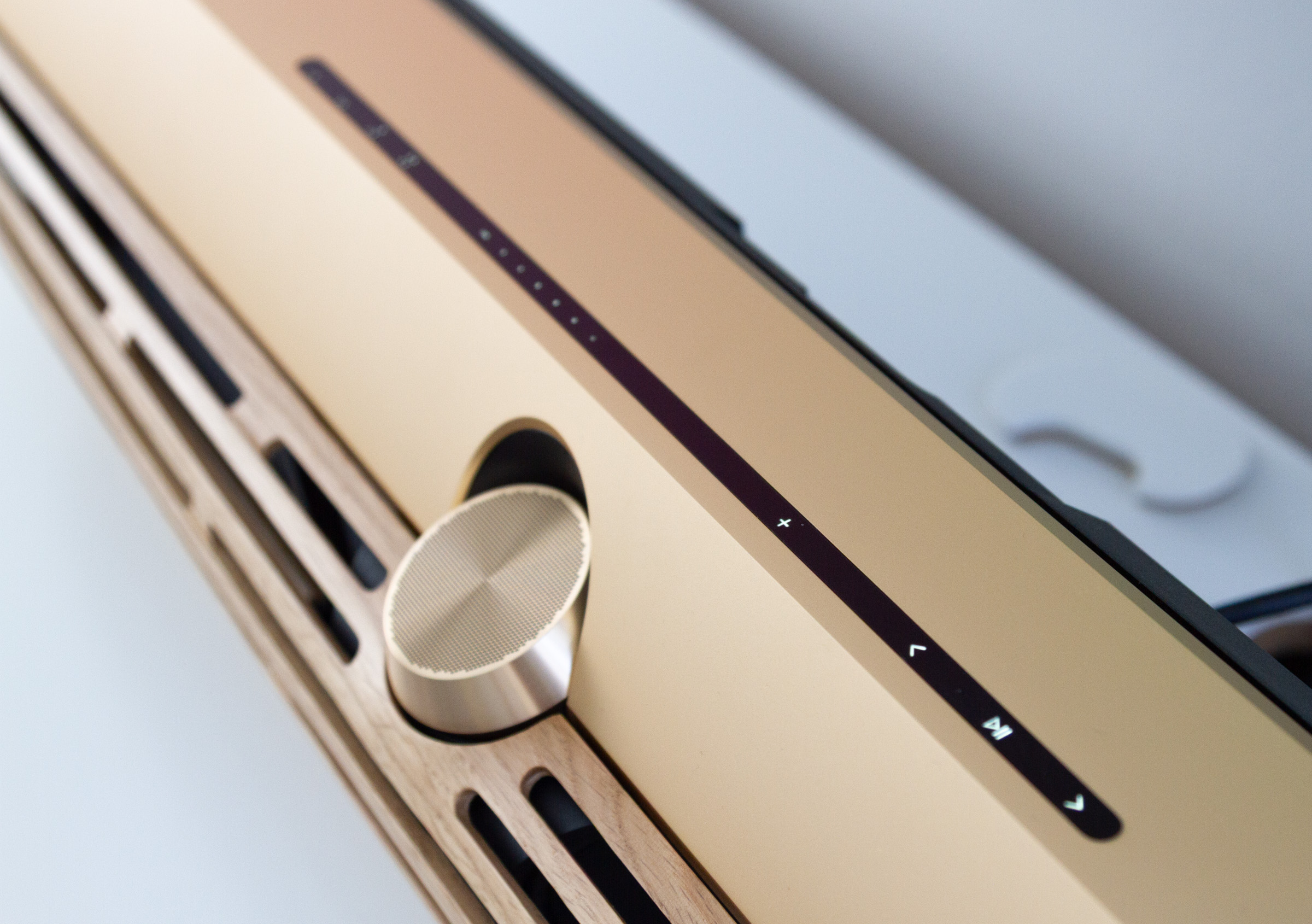
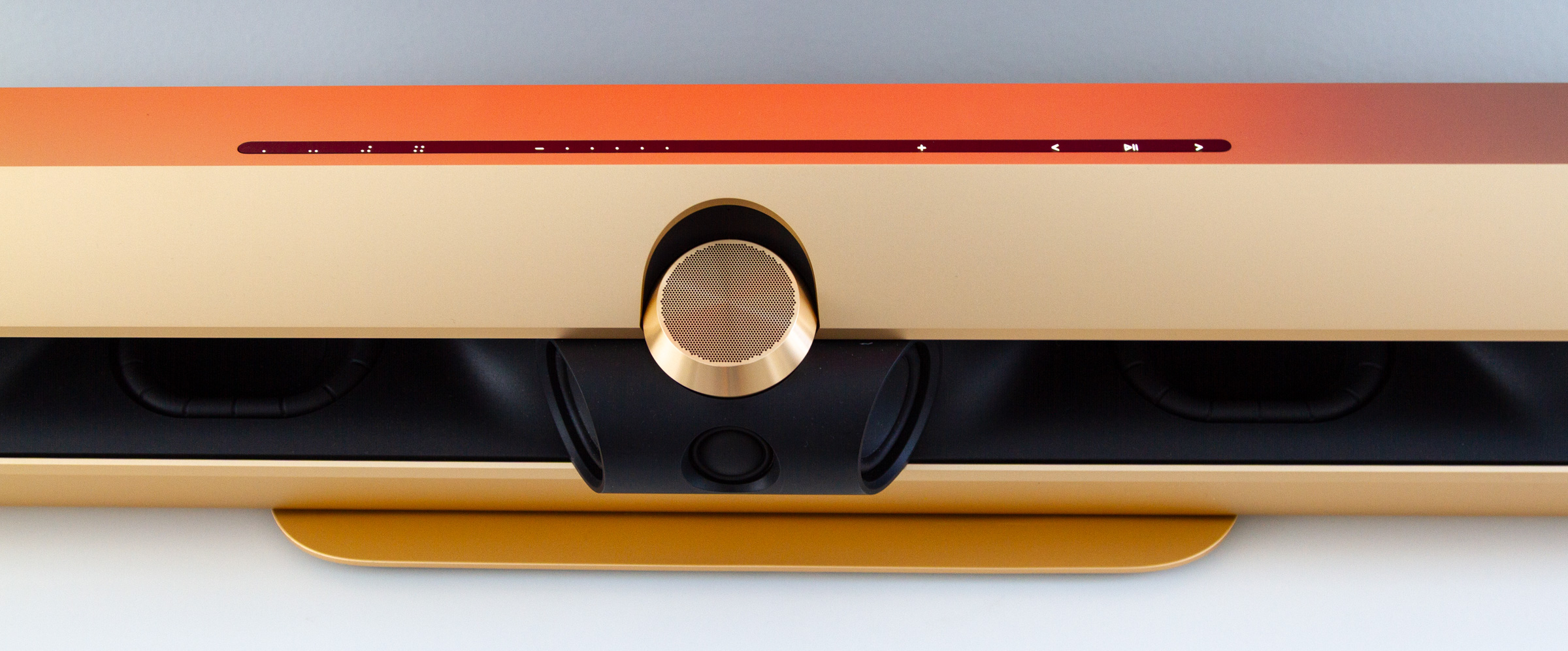
The touch panel on top lights up as you approach, while a light strip along the front displays the volume and provides subtle animations during power on and off. It's beautifully executed and contributes to the sense of a "living" design that B&O often strives for. Around the back you'll find the connections, hidden behind a removable cover, but unlike Theatre there is no built-in HDMI hub. Although there are Power Link outputs, only Mozart-compatible speakers are supported. You'll also find the LAN connection for an optional LG TV here, along with an analog line input via USB-C.
Less elegant is the fact that the chassis creaks during use as the unit warms up. It's a small detail, but one that breaks the illusion of uncompromising build quality. As far as we could determine, the creaking sound primarily came from the right-hand side of the speaker, where the power supply is located.
The touch panel on top of Beosound Premiere. Photo: Flatpanels
Setup
Setup is handled through the B&O app, which is fairly intuitive, and Premiere was automatically detected during the installation process. The app lets you configure the four music presets on top of the soundbar, assigning them to radio stations, Spotify playlists, or other audio sources. It makes more advanced features easily accessible, but it also means you're dependent on the app for future expansion and general configuration of Premiere – a dependency shared by most modern soundbars, so it's hardly unique to B&O (or to relying on the manufacturer's continued software support).
Multiroom functionality is available through B&O's own Beolink system, Google Cast, Spotify Connect or AirPlay. I tested AirPlay exclusively and the integration proved stable and seamless – albeit without Atmos support, which Apple still reserves for its own devices. A built-in microphone also allows Premiere to function as a Google Home device. For Dolby Atmos music playback, I instead used an Apple TV 4K.
One significant limitation quickly becomes apparent: Premiere can only be paired with Mozart-compatible speakers, and the lineup does not include a subwoofer. This also means that older B&O speakers, which can still be integrated with the more expensive Beosound Theatre, are not supported. That's a disappointing omission and one of the things that truly made Theatre unique, as B&O's knowledge of its complete speaker portfolio and the individual sound characteristics of each model allowed users to fine-tune the system with speakers spanning multiple generations. In practice, this meant I couldn't connect any of the B&O speakers I already have at home – neither Beolab 9 nor the WiSA-compatible Beolab 18. Premiere supports a maximum of four additional speakers, which is another notable difference compared to Theatre.
Theatre is, of course, a more sophisticated product with a significantly higher price tag, so it's only natural that some features have been omitted. Another difference is that room calibration on Premiere relies on a simple frequency sweep picked up by the soundbar itself, rather than calibrating specifically to your listening position on the sofa, as Theatre and many competing soundbars do. The channel configuration options are also more limited, although it is possible to create different listening modes with custom sound profiles and speaker assignments.
Premiere can function as a hub for an LG TV, allowing you to control the TV with a B&O remote as though it were a fully integrated B&O setup. We did not test Premiere with an LG TV, but the integration is expected to be just as seamless as on B&O's other soundbars.
It's worth noting that Premiere remained fully operational during firmware updates. Although the app's functions were temporarily unavailable, audio playback continued uninterrupted while the update was being installed.
Power consumption measured 6.3W in standby. With the soundbar powered on but idle, power consumption was 23W.
The B&O app controls Beosound Premiere. Photo: Flatpanels
Listening test: Music
Beosound Premiere delivers outstanding vocal reproduction that is both clear and natural. It's obvious that B&O has given voices high priority during the tuning process, but this also results in a very direct presentation, as dialog and vocals are reproduced primarily by the centrally positioned tweeter. As a consequence, the stereo soundstage is relatively narrow. Dolby Atmos music adds a bit more width through the upward- and side-firing drivers, but it never reaches the level of systems with multiple physical speakers. The room is never completely filled with sound, leaving you with the impression that everything is coming from a single speaker, albeit a very capable one.
Bass performance is respectable at moderate listening levels, but as the volume increases it quickly becomes boomy and loses composure. This is where the absence of a dedicated subwoofer really becomes apparent. While the bass often feels powerful, it never reaches truly deep, and I frequently found myself missing the extra punch delivered by soundbars such as Beosound Theatre or Sennheiser Ambeo Max. Compared to something like Sonos Arc Ultra, which received considerable praise for its redesigned woofers, Premiere certainly doesn't come up short – in fact, it delivers noticeably more low-frequency output.
B&O's traditional sound signature has long leaned toward a mild V-shaped tuning, emphasizing vocals and bass, and Premiere follows the same philosophy. However, without a dedicated subwoofer, the bass lacks both depth and authority, especially when compared to Beosound Theatre or soundbars paired with an external subwoofer.
Premiere is perfectly capable of serving as the main music system in a living room, but music enthusiasts will likely feel that something is missing. The very lowest frequencies lack a bit of impact, and more importantly, the soundstage could be wider. You can add front speakers such as Beolab 8 or Beolab 28, but these speakers cost either roughly as much as Premiere itself or several times more. It seems to me that if you're prepared to invest in a pair of Beolab 28s for your Atmos setup, you'll probably choose Beosound Theatre rather than Premiere as your soundbar.
Listening test: Movies
When watching movies, Premiere's vocal reproduction is once again one of its greatest strengths. Dialog remains crystal clear and intelligible, even in complex movie soundtracks. However, achieving anything resembling a convincing Atmos effect requires turning the volume up fairly high – and once you do, the direct sound becomes almost too dominant. Fortunately, you can adjust the side- and height-channel levels independently, and in my room I ended up increasing both by a couple of decibels to prevent the center channel from overwhelming the presentation.
The lack of a dedicated subwoofer is even more apparent with movies than with music. Explosions, deep bass effects, and large cinematic soundscapes lack the physical impact that a subwoofer normally provides. The Atmos effect is certainly present, but it doesn't compete with the likes of Sonos Arc Ultra or especially Sennheiser Ambeo Max, both of which create a more immersive and spacious surround experience as standalone soundbars. Looking purely at this price segment, it's also worth noting that both systems can be expanded with speakers from their respective ecosystems while still costing less than a Beosound Premiere. Quite simply, you'll get more Atmos for your money elsewhere, but from products aimed at a different audience, naturally.
B&O has previously stated that it prioritizes natural sound reproduction over "Atmos flashiness", and that philosophy is evident here. Premiere doesn't try to impress with exaggerated surround effects, but the result is that, without additional speakers, it feels more like a substantial upgrade over your TV's built-in speakers than a fully realized Atmos solution. To achieve a truly convincing surround experience, you should plan on adding speakers to both the front sides and the rear. Adding, for example, four Beolab 8 speakers will also improve bass performance, as B&O's bass management system is designed to route low frequencies to the most capable speakers in the system. That's worth keeping in mind if you're considering smaller speakers such as Emerge or Level.
It's also worth spending a few extra words on what you actually gain by investing in Beosound Theatre instead of Premiere, considering the price is at least 2.5 times higher, and more than six times higher if you indulge in premium finishes and the floor stand. Beosound Theatre remains B&O's most complete TV audio solution. While the two products share the same design DNA and user interface, their audio philosophy and technical ambitions differ significantly.
At its core, Theatre is a full surround hub capable of integrating a wide range of both new and legacy Beolab speakers. This makes it an exceptionally flexible platform for building a complete Atmos system with dedicated side, height, rear, and subwoofer channels. Theatre leverages B&O's extensive database of speaker characteristics to optimize sound distribution, ensuring that every connected speaker plays a specific role within the overall soundstage. It's one of the features that made Theatre one of B&O's most impressive products in recent years.
Theatre's aluminum "wings" are also available in different widths to match 55-, 65-, and 77-inch TVs, making it a more complete companion for a flat-panel TV – particularly those from LG. Add to that an extensive selection of finishes, colors, and front covers – enough to make even a Porsche enthusiast jealous – and you end up with a product whose design clearly targets a far more discerning audience.
Beosound Premiere with and without the front grille. Photo: Flatpanels
Premiere takes a different approach. It's simpler, more furniture-like, and less flexible, although it retains some of its bigger sibling's features. Limiting expansion to Mozart-compatible speakers, and the absence of a matching subwoofer, means that Premiere cannot evolve into a full surround system in the same way as Theatre. On the other hand, configuring Premiere is considerably simpler. Theatre offers an overwhelming number of configuration options, to the point where setup can almost become a job for a professional installer. It's clearly a strategic decision by B&O. For now, Premiere is a more closed ecosystem, but also a more approachable one.
The sonic differences are clear:
Theatre delivers substantially deeper bass and greater dynamic range, especially with movies. Its integrated woofer section is significantly more powerful than Premiere's bass system, producing physical low-frequency impact that Premiere simply cannot match.
The Atmos effect is superior on Theatre in terms of width, height, and depth. It creates a more enveloping soundstage even without additional speakers, while also offering far greater flexibility for expanding the system.
Premiere places greater emphasis on clarity and refinement, particularly in vocal reproduction. It delivers a highly controlled and well-balanced presentation at moderate listening levels, but lacks the authority and spaciousness that Theatre is capable of producing.
Conclusion
Ad:
Beosound Premiere is an exclusive, beautifully crafted soundbar that delivers outstanding vocal reproduction and a generally well-balanced sound at moderate listening levels. The design is bold and likely to divide opinion, but the materials and craftsmanship are impeccable.
Setup is straightforward, but the restriction to Mozart-compatible speakers and the lack of a matching Mozart-compatible subwoofer significantly reduce its flexibility. Sonically, Premiere excels in clarity but falls short in bass depth, soundstage width, and the spacious presentation you'd expect from a Dolby Atmos soundbar at this price.
For users looking for an elegant, integrated solution centered around exceptional vocal clarity and B&O's distinctive design language, Premiere is an attractive option. However, those seeking a truly immersive Atmos experience, or a system that can be expanded with existing B&O speakers, will encounter clear limitations at this time.
Price and retailer:
Clear sound with excellent vocal reproduction Good bass for a soundbar without a subwoofer Premium materials and craftsmanship Supports wireless front and rear speakers
Dolby Atmos performance Supports only Mozart-compatible speakers No matching subwoofer available Chassis creaks during use