Following a panel discussion with Warner Bros and IMAX at CEDIA, the 8K Association has shared a status update on 8K movies. Warner has now scanned 35-40 titles in 8K or higher.
The session, titled 'From Classics to Cutting Edge', featured Greg Ciaccio, VP of Post Production Original Content & Image Capture at IMAX, and Miles DelHoyo, Executive Director of Technical Strategy & New Format Integration at Warner Bros Discovery.
It focused on the industry's work with 8K and higher resolutions, but the discussion offered interesting insights into the current state and future direction of 8K technology.
Also read: 8 reasons why you still shouldn't buy an 8K TV
35-40 titles scanned in 8K at Warner
Miles DelHoyo revealed that Warner has scanned 35-40 titles in 8K or higher over the past 2-3 years, up from approximately 20 titles in early 2025 – indicating that the pace is accelerating.
- "DelHoyo explained that at WB, the 8K effort is mainly concentrated around preservation rather than on distribution. The aim is to scan the full catalog in ultra high resolution at 8K (or even higher) to capture all the content that is in the original," wrote the 8K Association. "So far, most of the delivery work has been on 4K HDR content but he said that an 8K version could be released later. The firm is getting as much content as possible into the archive in 8K."
According to DelHoyo, scanning a 35mm film in 8K takes roughly 3.5 times longer than 4K. Seven of the films were originally shot in 65mm, at least four in Vistavision and one in Technorama, while many were 35mm titles, where 8K likely represents the upper limit of useful resolution, depending on film stock, lenses and other factors, he said. All of this is part of the preparation required before 8K movies can make their way to viewers.
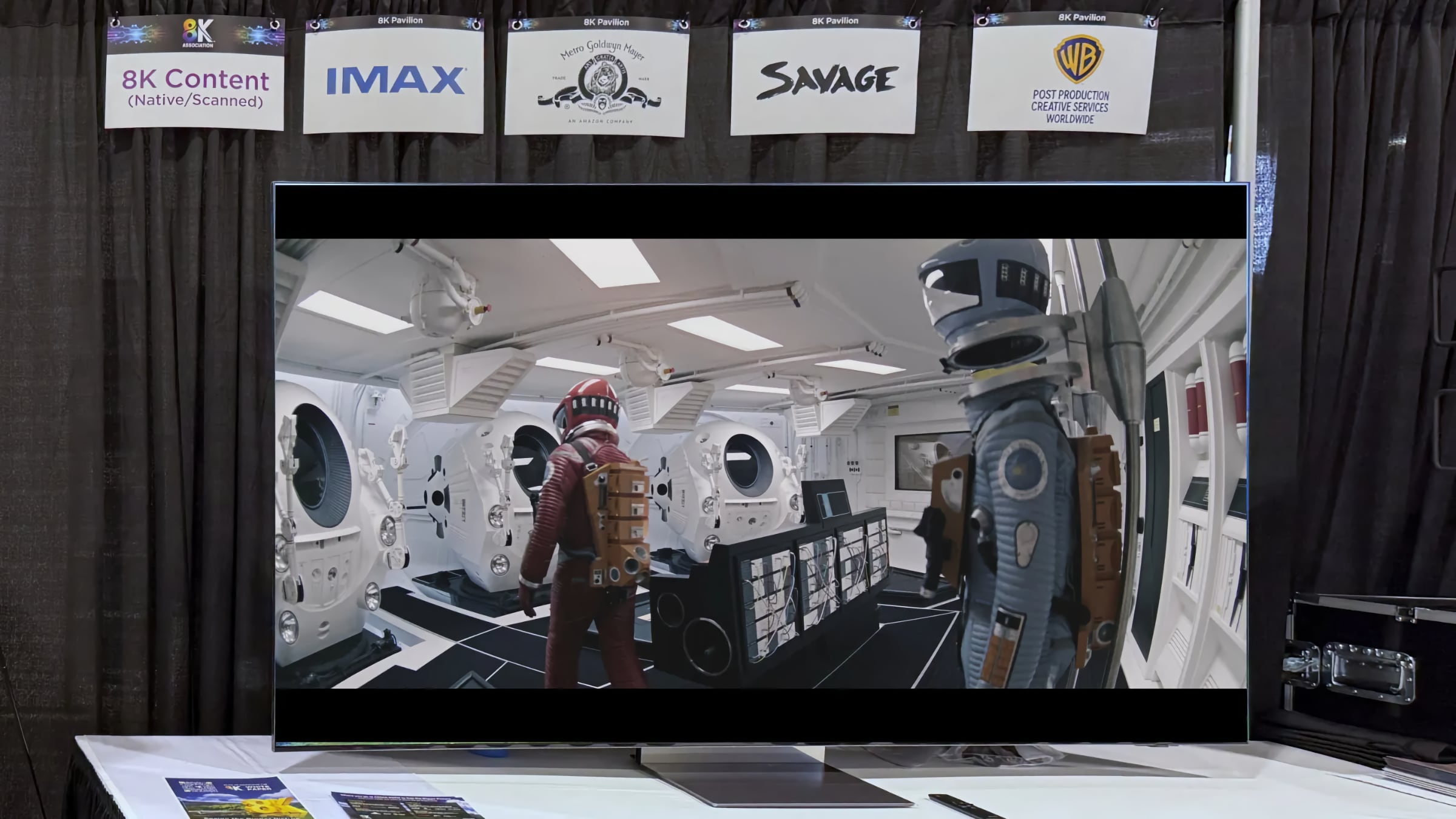
Warner titles scanned in at least 8K (but released in 4K) include 2001: A Space Odyssey, Oppenheimer, Lethal Weapon, Dirty Harry, Sinners, Purple Rain, Rebel Without a Cause, The Wizard of Oz, My Fair Lady, Blade Runner (1982) and Chapter 51, as well as North by Northwest, High Society, The Searchers and West Side Story (1961) in Vistavision.
FlatpanelsHD has previously viewed an 8K scene from Warner's and Christopher Nolan's Dunkirk where detail suffered due to its low 24fps frame rate.
Samsung has also previously showcased 8K clips from Creed III, Barbie, Blue Beetle, Dune: Part Two, Wonka and Aquaman and the Lost Kingdom.
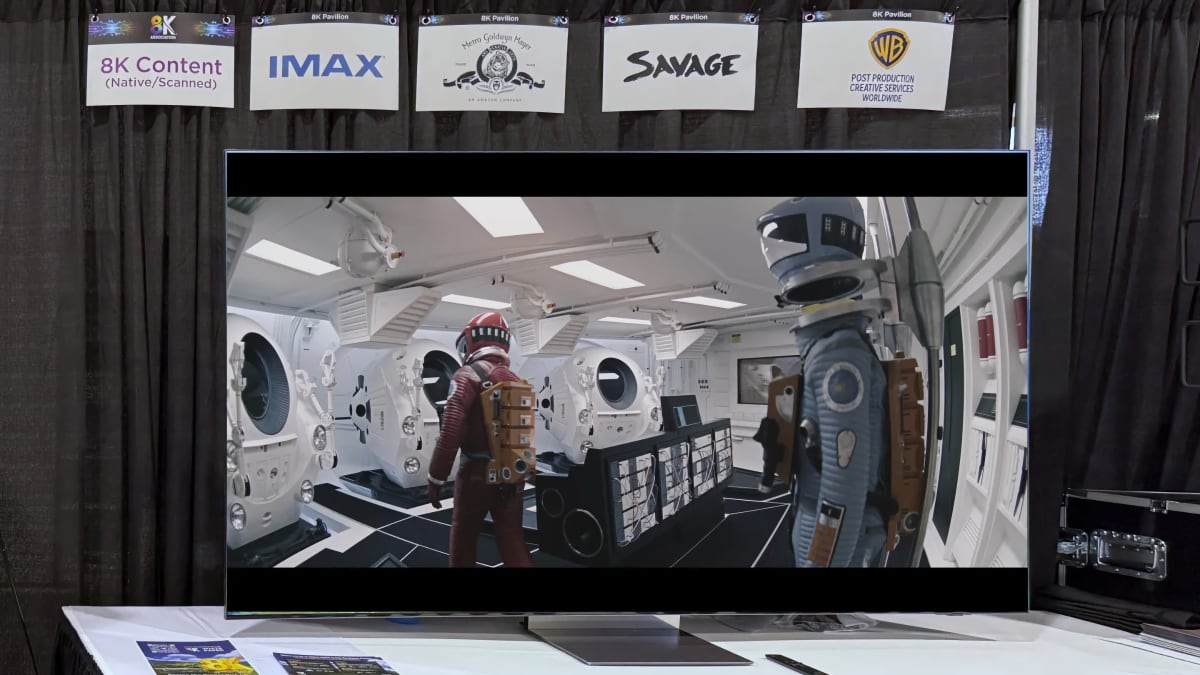 Clips from the restored version of 2001: A Space Odyssey in 8K shown at CEDIA. Photo: 8K Association
IMAX pushes beyond 8K
IMAX's Greg Ciaccio noted that the IMAX film format can theoretically reach 18K, though in the digital realm it currently uses a Lasergraphics Director 13.5K scanner. IMAX has been working on 8K since 1972, he said.
All post-production today is digital. For major releases such as Christopher Nolan's Oppenheimer, studios are working in 8K.
However, most VFX and CGI work continues to be rendered in 2K resolution.
8K at home before cinema
Ciaccio also shared his view that the 8K ecosystem will take hold in homes — through TVs and headsets — before it reaches cinemas.
- "Ciaccio pointed out that TV and headsets are likely to go 8K before cinema does as there is not yet a DCI standard for 8K digital cinema. He has the advantage of seeing the original film versions, with fantastic resolution, but if you see the DCI version, the resolution goes down," wrote the 8K Association.
- "TV sets are getting bigger and bigger, but the screen is staying at the same distance, so you need more pixels, Ciaccio said. Immersive sound is also important, and in the future 8K per eye headsets will drive immersive experiences."
IMAX has been experimenting with 2D and 3D movies. on Apple Vision Pro.
Also read: First look at Apple Vision Pro: A video revolution
8K LCD TVs are already available but remain expensive and underwhelming compared to 4K OLED TVs, while current VR headsets typically offer around 4K — or lower — resolution per eye.
- Source: 8K Association